

Contents In This Blog
Why Camera Uptime Requires Governance, Not Just Technology
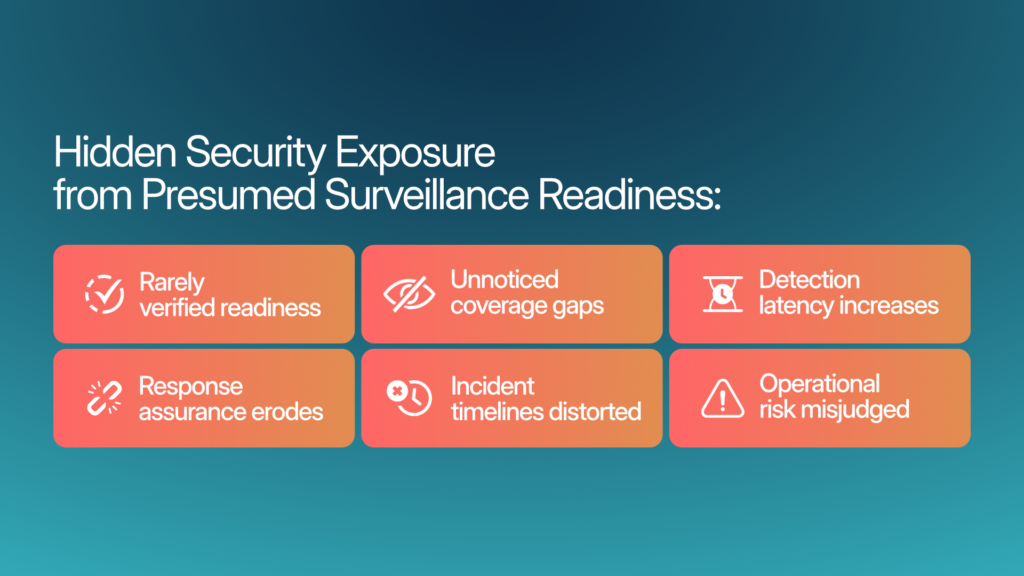
Most security programs operate on an assumption that cameras are always available. That assumption typically goes unchallenged until an incident occurs and critical footage is missing.
Uptime monitoring shifts this risk from assumption to assurance by identifying camera downtime and feed interruptions, maintaining continuous surveillance readiness, and supporting structured reporting and audit requirements.
Common Camera Uptime Failures Across Industrial Environments
- Power instability and local breaker trips
- Network congestion and packet loss
- VMS/NVR failures
- Lens obstruction (dust/insects/condensation)
- Camera drift from vibration or wind
- Silent configuration changes during maintenance
Core Capabilities of Security Systems with Camera Uptime Monitoring
Features
Outcomes
- Downtime and feed interruption detection
- Continuous surveillance readiness
- Audit-ready reporting
- Uptime SLAs by zone criticality
- Root-cause tagging (power/network/device/obstruction)
- Closure workflow for corrective actions
A Practical Readiness Governance Model
1) Classify cameras by criticality
Perimeter and restricted zones should have the highest uptime targets.
2) Define uptime SLAs and alerting thresholds
- Critical cameras: Immediate alert on interruption
- Non-critical: Periodic digest + Tickets
3) Assign ownership
- IT/OT for network/power
- Security for placement and coverage
- Vendor or maintenance for hardware
4) Run weekly readiness reviews
Track downtime minutes per camera and close corrective actions.
Evaluation metrics
- Uptime % by zone
- Mean time to detect downtime
- Mean time to restore
- Cameras with repeat failures (top 10)
FAQs
1. What is camera uptime monitoring?
Continuous monitoring that detects downtime and feed interruptions to ensure surveillance readiness.
2. Why does uptime matter for audits?
If cameras are down, you cannot prove readiness or provide evidence during investigations.
3. How do you prioritise which cameras need the highest uptime?
By zone criticality: perimeter, restricted zones, and high-risk operational areas first.
4. How do you reduce repeat downtime?
Tag root causes and enforce closure workflows (network, power, hardware, obstruction).
5. Does uptime monitoring replace maintenance?
No. It creates visibility and prioritisation, so maintenance is targeted and auditable.
6. Can uptime monitoring integrate into reporting?
Yes, your page positions it as supporting operational reporting and audit requirements.
Continuous monitoring that detects downtime and feed interruptions to ensure surveillance readiness.
If cameras are down, you cannot prove readiness or provide evidence during investigations.
By zone criticality: perimeter, restricted zones, and high-risk operational areas first.
Tag root causes and enforce closure workflows (network, power, hardware, obstruction).
No. It creates visibility and prioritisation, so maintenance is targeted and auditable.
Yes, your page positions it as supporting operational reporting and audit requirements.
Are you ready to experience T-Pulse?
Meet highest compliance, monitor all occupational risks, and get recommended actions to achieve global safety benchmark. Schedule a demo
