
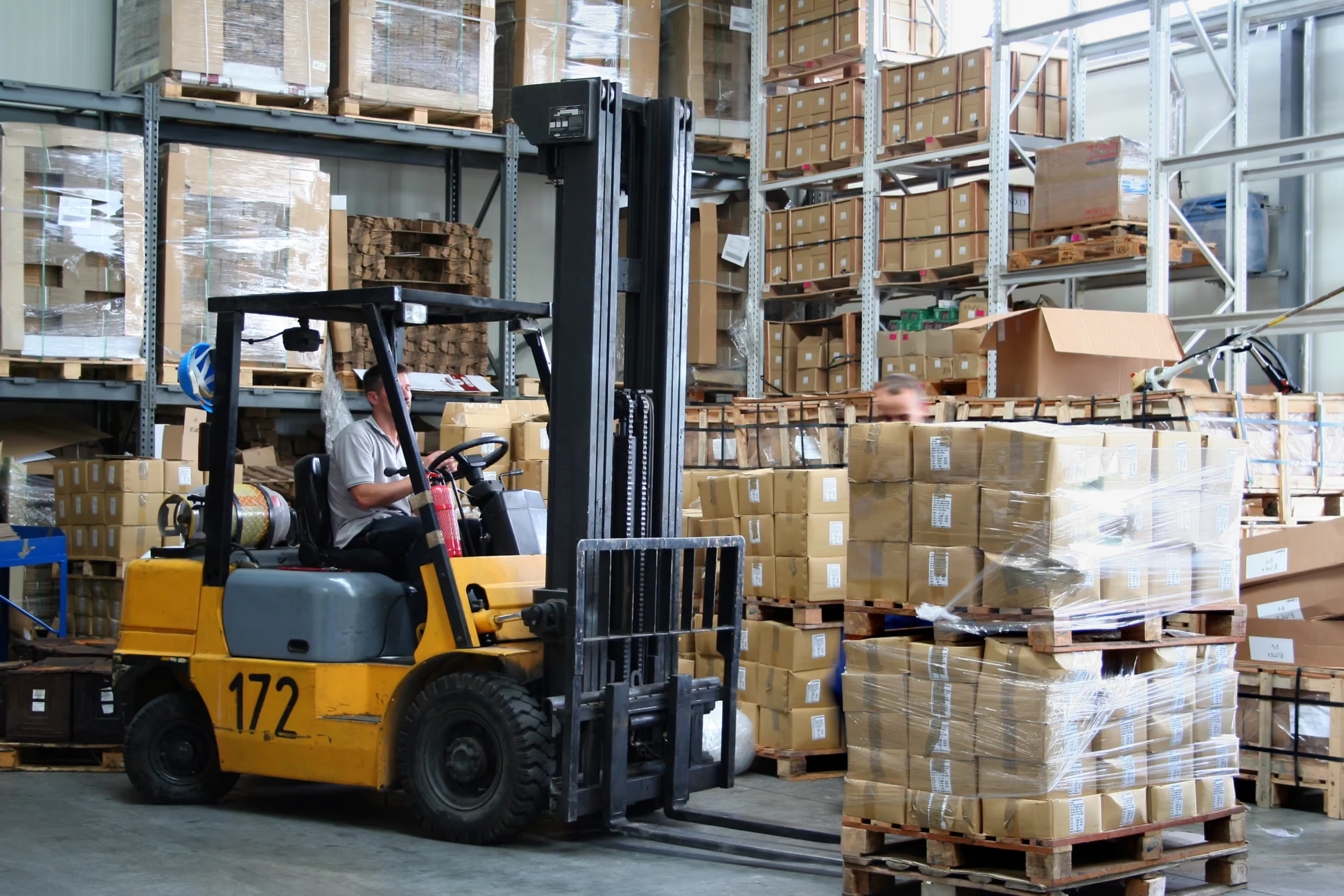

Forklift operations remain central to warehouse productivity, yet every interaction between equipment, pedestrians, and surrounding infrastructure introduces a degree of operational risk. Despite continued investments in training and established safety procedures, forklift-related workplace fatalities still occur, reinforcing that collision risk remains a persistent challenge across modern warehouse environments.
Reducing that exposure depends on more than detecting a developing hazard. Operators need alerts they can quickly understand, trust, and act on without creating unnecessary disruption to material flow. As warehouse operations become more dynamic, alert quality increasingly influences decision consistency, vehicle control, and execution reliability. This article examines how intelligent forklift alerts strengthen operator trust and support higher-quality responses across daily operations.
Why Detection Alone Does Not Produce Better Safety Outcomes
Detecting a potential hazard is an important first step, but it does not automatically improve safety outcomes. The operational value of detection depends on whether operators can quickly interpret the developing interaction, understand its significance, and take proportionate action within the available response window.
This distinction becomes increasingly important as warehouse environments grow denser and interactions become more dynamic. Alerts that communicate risk without sufficient context can leave additional interpretation to the operator at precisely the moment when decisions must be made quickly. Intelligent alerting closes this gap by turning detected activity into relevant information that supports timely, confident, and controlled operator action.
How Intelligent Forklift Alerts Turn Detection into Actionable Decisions
High-performing warehouse operations depend not only on identifying developing risks, but on communicating them in a form operators can immediately interpret and act upon.
Detect Technologies’ Intelligent Collision Avoidance System (ICAS) combines forklift-mounted cameras, computer vision, and AI-powered video analytics to continuously interpret surrounding activity and convert real-time detection into context-aware operator alerts.
ICAS transforms real-time detection into decision-ready information through:
- Context-aware object interpretation: Distinguishes relevant risks from routine warehouse activity, helping focus operator attention where intervention is required.
- Directional and proximity analysis: Identifies where a developing interaction is occurring and communicates its urgency to support an appropriate response.
- Configurable alert logic: Aligns alert priority with defined risk thresholds, supporting proportionate responses across different warehouse operating conditions.
- Real-time risk qualification: Continuously evaluates evolving interactions so operators are alerted when conditions indicate meaningful collision potential.
By qualifying risk before communicating it, ICAS provides operators with clearer decision context, strengthening confidence in alerts and supporting more consistent responses during active warehouse operations.
Operational Impact of Intelligent Forklift Alerts
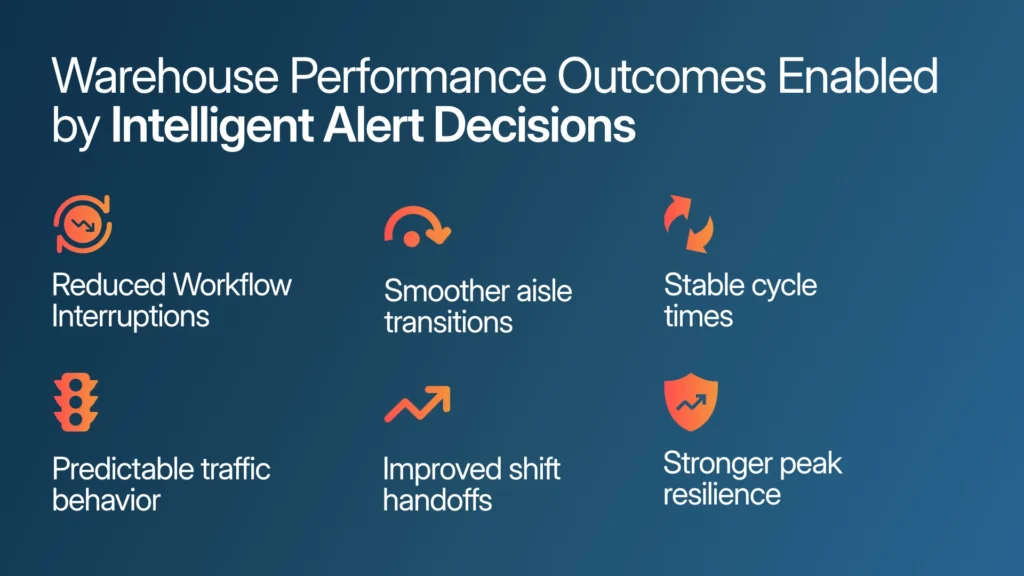
When intelligent alerts consistently support appropriate operator responses, their value extends beyond individual collision events into the reliability of warehouse execution.
- Response Standardization:Establishesmore consistent operator responses to comparable risk conditions, reducing behavioral variability across shifts and operating environments.
- Execution Continuity:Limits unnecessary stops and abrupt interventions, helping material handling activities continue without avoidable disruption to connected workflows.
- Adaptive Operations:Supports controlled operator responses as traffic density, workloads, and pedestrian activity change across different operating periods.
- Scalable Performance:Creates a consistent alerting framework that helps standardize forklift safety practices across facilities, fleets, and workforce profiles.
Evaluating Alert Performance Across People, Equipment, and Shifts
Evaluating intelligent alert performance requires leaders to look beyond individual events and examine whether response quality remains consistent across operating conditions.
- Response Quality Index:Evaluate operator decisions across comparable risk interactions todetermine whether alerts are producing timely, proportionate, and repeatable responses.
- Workforce Performance Alignment:Compare alert interpretation across experienced, temporary, and contractor personnel toidentify response gaps between different workforce profiles.
- Fleet-Wide Consistency:Assess alert performance across forklift types and configurations to verify consistent response quality throughout mixed-fleet operations.
- Shift-Level Operational Stability:Track response patterns across shifts toidentify variations that may require targeted training or operational adjustments.
- Continuous Performance Benchmarking:Establishperformance baselines across operational groups and track changes over time to validate sustained alert effectiveness.
Building a Trusted Alerting Strategy Across Warehouse Operations
Intelligent alerting becomes most valuable when it is embedded into warehouse operations as a repeatable decision-support capability. By aligning alert quality with operator response and continuously evaluating performance across people, equipment, and shifts, leaders can build greater consistency into how developing risks are managed across the operation.
Detect Technologies' ICAS enables this approach by converting real-time operating conditions into relevant, context-aware alerts operators can act upon with confidence. Explore how intelligence can strengthen operator trust and response quality in your facility. Schedule a personalized ICAS demo for your operating environment.
FAQs
1. Why does alert quality matter in forklift collision avoidance?
Alert quality determines whether operators can quickly understand a developing risk and respond appropriately. Relevant, contextual alerts reduce risk interpretation complexity and provide clearer decision support within the available response window.
2. How can intelligent alerts improve forklift operator response quality?
Intelligent alerts provide decision context that helps operators interpret developing interactions and take proportionate action. This supports more timely, controlled, and repeatable responses across comparable risk situations.
3. How does ICAS distinguish relevant risks from routine warehouse activity?
ICAS continuously interprets surrounding activity using computer vision and AI-powered video analytics. Context-aware object interpretation and real-time risk qualification help distinguish interactions requiring operator attention from routine activity around the forklift.
4. How can warehouse leaders evaluate intelligent alert performance?
Leaders can compare response quality across similar interactions, workforce profiles, forklift configurations, shifts, and operating conditions. Establishing performance baselines and tracking changes over time helps determine whether alert effectiveness remains consistent as operating conditions evolve.
5. Can intelligent forklift alerting scale across large, mixed-fleet warehouse operations?
Yes. Intelligent forklift alerting can support mixed-fleet environments by establishing a consistent alerting framework across different forklift types and configurations. This helps organizations standardize response quality and safety practices while maintaining consistency across shifts, workforce profiles, and facilities.
Alert quality determines whether operators can quickly understand a developing risk and respond appropriately. Relevant, contextual alerts reduce risk interpretation complexity and provide clearer decision support within the available response window.
Intelligent alerts provide decision context that helps operators interpret developing interactions and take proportionate action. This supports more timely, controlled, and repeatable responses across comparable risk situations.
ICAS continuously interprets surrounding activity using computer vision and AI-powered video analytics. Context-aware object interpretation and real-time risk qualification help distinguish interactions requiring operator attention from routine activity around the forklift.
Leaders can compare response quality across similar interactions, workforce profiles, forklift configurations, shifts, and operating conditions. Establishing performance baselines and tracking changes over time helps determine whether alert effectiveness remains consistent as operating conditions evolve.
Yes. Intelligent forklift alerting can support mixed-fleet environments by establishing a consistent alerting framework across different forklift types and configurations. This helps organizations standardize response quality and safety practices while maintaining consistency across shifts, workforce profiles, and facilities.
Are you ready to experience T-Pulse?
Meet highest compliance, monitor all occupational risks, and get recommended actions to achieve global safety benchmark. Schedule a demo
