
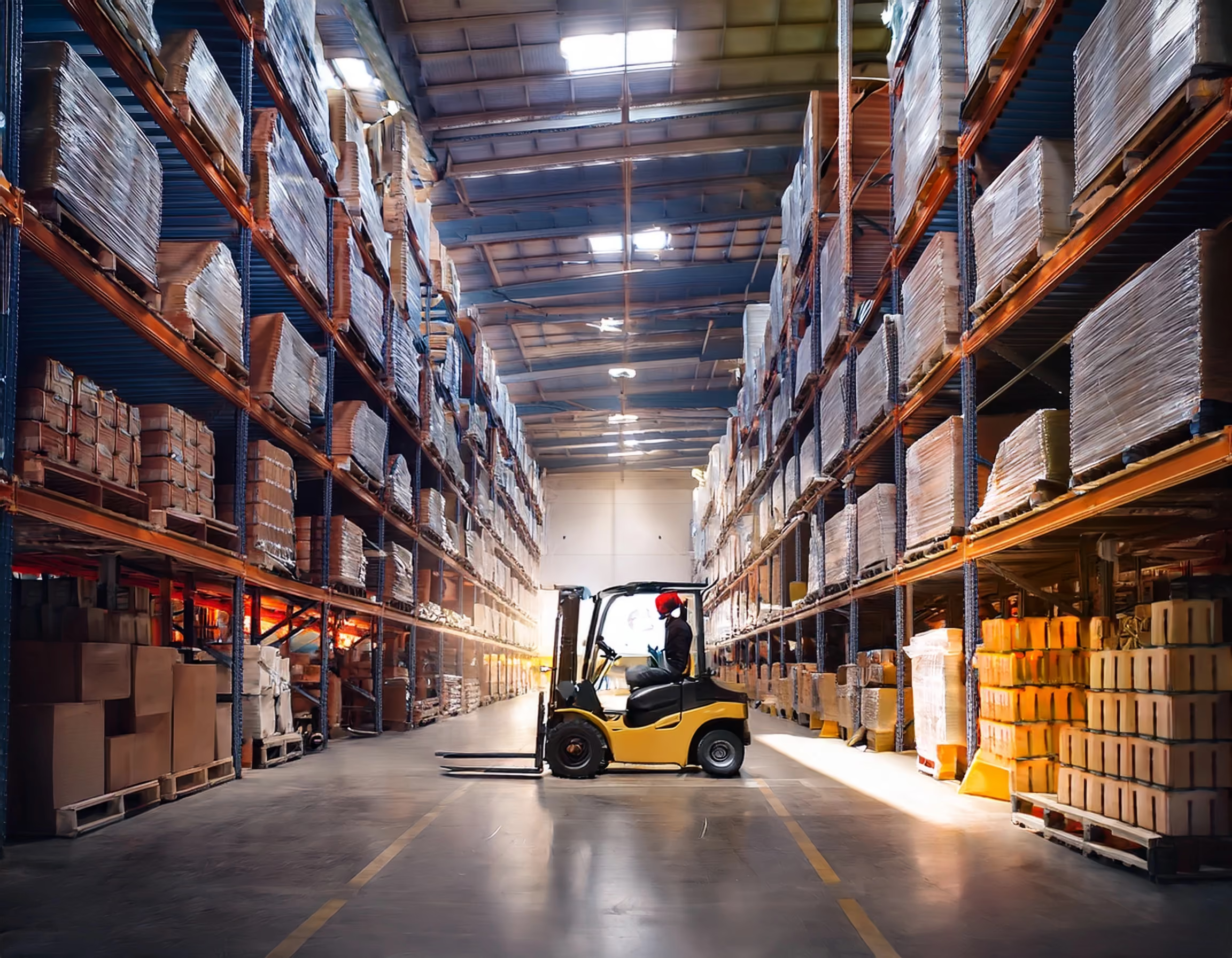

Despite comprehensive training programs, established procedures, regular audits, and certified operators, forklift-related incidents continue to rank among the leading causes of workplace injuries in industrial environments worldwide.
The fundamental issue is not a lack of safety awareness or effort. It is that most warehouse safety systems remain largely reactive, while the risks they aim to address are dynamic, interconnected, and continuously evolving.
Modern warehouses operate under intense conditions such as high throughput pressure, space constraints, dense layouts, mixed traffic of pedestrians and material handling equipment, and limited real-time visibility into unsafe behaviors. These factors create persistent safety gaps that traditional controls alone struggle to close.
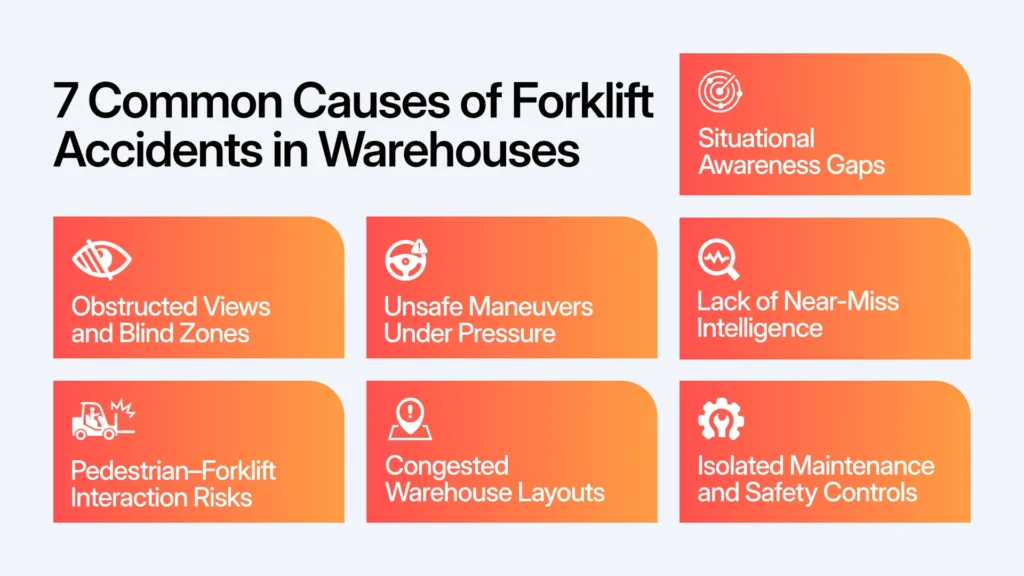
7 Critical Causes of Forklift Accidents in Modern Warehouses
Each of the following causes serves as more than a surface-level risk. Together, they reveal the structural limitations of traditional safety approaches in today’s high-pressure warehouse environments.
1. Operator Blind Spots and Visibility Constraints
Forklift design combined with elevated loads, dense racking, and narrow aisle intersections, creates persistent blind zones. Operators must constantly compensate using mirrors, body positioning, and experience, all while managing speed and load stability. This highlights an over-reliance on individual operator judgment in situations where human perception has inherent limitations.
2. Uncontrolled Pedestrian–Forklift Interactions
Many facilities still rely primarily on painted walkways and basic signage to separate people and equipment. During peak operations or layout changes, these passive controls are frequently bypassed due to operational urgency. This reveals a lack of active monitoring or enforcement capability when pedestrians and forklifts share the same space in real time.
3. Unsafe Driving Behavior Under Operational Pressure
Speeding, harsh braking, and improper turning are frequent symptoms of productivity targets rather than deliberate risk-taking. Behavioral risks are not always individual failings, they are often responses to systemic pressure. When performance metrics emphasize speed over safety, unsafe habits can become normalized, showing that most safety systems lack real-time visibility into driving behavior and immediate corrective mechanisms.
4. Inefficient Layout and Traffic Flow Design
Congested aisles, intersecting routes, and poor zoning often remain unaddressed because layout decisions are largely static and lack the benefit of ongoing operational data. Without continuous insights into traffic density and movement patterns, high-risk zones are difficult to identify and optimize proactively.
5. Training Gaps and Situational Awareness Limitations
While training provides foundational knowledge, it cannot fully prepare operators for every dynamic hazard they will encounter in fast-moving, high-density environments. This points to an over-reliance on human reaction time in conditions where reaction windows are frequently insufficient.
6. Absence of Near-Miss Intelligence
Most organizations track completed incidents but capture very few near-misses, even though these events occur far more frequently and serve as leading indicators of future accidents. Without systematic near-miss data, safety teams operate with an incomplete picture and are forced to react to serious incidents rather than prevent them by addressing recurring patterns early.
7. Equipment Condition and System Limitations
Mechanical wear, sensor issues, and the absence of integrated safety systems reduce an operator’s ability to respond effectively. Safety is often treated as a people and process issue, while equipment condition is managed through separate maintenance programs creating dangerous blind spots in overall risk management.
The Fundamental Limitation
In a busy warehouse, a forklift moving at moderate speed can cover several meters in a single second. Human reaction time alone is often insufficient to prevent collisions in blind intersections, high-density zones, or sudden pedestrian crossings. This is the core constraint of traditional safety systems: they depend on people to see, interpret, and react perfectly under conditions that frequently challenge human capability.
Transitioning to Intelligent, Proactive Safety
To close this gap, safety systems must evolve from passive controls to active, real-time risk prevention. An intelligent collision avoidance system functions as an additional layer of perception by continuously monitoring surroundings using vision-based AI, detecting pedestrians, forklifts, and obstacles in real time, triggering instant alerts, capturing near-miss data, and identifying high-risk zones and recurring patterns.
This transforms safety from reactive to predictive, manual to automated, and compliance-driven to intelligence-driven.
Ready to strengthen forklift safety in your operations? Discover how Detect Technologies’ Intelligent Collision Avoidance System can provide the real-time detection and actionable insights your facility needs.
Request a Demo or Site Assessment
FAQs
1. Why do forklift accidents continue to occur despite strong training and safety programs?
Most existing programs are reactive and depend heavily on consistent human performance. In dynamic warehouse environments, human reaction time and attention have natural limits. Intelligent systems add reliable real-time detection and alerts that complement human efforts.
2. Can traditional mirrors and spotlights be combined with intelligent detection? What is the biggest gap in current forklift safety approaches?
The biggest gap is the lack of real-time, proactive hazard detection and objective near-miss data. Traditional controls are mostly passive, while risks in modern warehouses are constantly changing.
3. How does Intelligent Collision Avoidance System (ICAS) help reduce these risks?
ICAS analyzes live visual inputs from forklift-mounted cameras using on-device AI processing and computer vision. It detects pedestrians, vehicles, and obstacles in real time, triggers immediate alerts, and captures near-miss data to help teams address recurring collision risks earlier.
4. Is intelligent collision avoidance system suitable for warehouses with temporary and contractor staff?
Yes. Its tagless operation makes it highly effective for mixed and variable workforces, which are common during peak seasons and high-throughput periods.
5. What results can organizations realistically expect after implementing intelligent collision avoidance?
Facilities typically see a measurable reduction in near-misses and incidents, improved safety data for continuous improvement, lower downtime, and greater confidence among operators and safety teams.
Most existing programs are reactive and depend heavily on consistent human performance. In dynamic warehouse environments, human reaction time and attention have natural limits. Intelligent systems add reliable real-time detection and alerts that complement human efforts.
The biggest gap is the lack of real-time, proactive hazard detection and objective near-miss data. Traditional controls are mostly passive, while risks in modern warehouses are constantly changing.
ICAS analyzes live visual inputs from forklift-mounted cameras using on-device AI processing and computer vision. It detects pedestrians, vehicles, and obstacles in real time, triggers immediate alerts, and captures near-miss data to help teams address recurring collision risks earlier.
Yes. Its tagless operation makes it highly effective for mixed and variable workforces, which are common during peak seasons and high-throughput periods.
Facilities typically see a measurable reduction in near-misses and incidents, improved safety data for continuous improvement, lower downtime, and greater confidence among operators and safety teams.
Are you ready to experience T-Pulse?
Meet highest compliance, monitor all occupational risks, and get recommended actions to achieve global safety benchmark. Schedule a demo
