
Most discussions on leveraging AI in turnarounds remain conceptual, emphasizing on emerging technologies such as predictive maintenance, digital twins, and computer vision rather than execution.
In practice, when planners and TA managers sit down to prepare for a real shutdown, they face more pressing questions like:
- How does AI fit into current workflows?
- Which decisions does it genuinely improve?
- What data does it rely on, and is that data already in place?
This article takes a practitioner’s lens, examining how AI can be embedded across the turnaround value chain without breaking existing processes or introducing operational disruption.
Contents In This Blog
The Real AI Value in Turnarounds: Sharper Decisions, Reduced Friction
Every turnaround progress through a familiar sequence—scope, readiness, execution, and close-out. At each stage, teams make high-stakes decisions using fragmented, inconsistent, or late data. When AI is leveraged effectively, it adds value by sharpening decisions, making trade-offs explicit, and aligning plans with execution.
But this impact is achieved only when AI is implemented with discipline, guided by 4 core principles:
1) AI augments, never overrides human judgment
Turnaround accountability remains firmly with planners and TA managers. AI serves as a decision-support mechanism, offering contextual second opinions such as risk scores, readiness indicators, and reforecasts which teams can interrogate, validate, and refine before acting.
2) Embed AI inside existing workflows
Adoption declines when AI operates outside established workflows. Insights must surface directly within the control tower views teams already use grids, heatmaps, S-curves, action registers and remain integrated with daily work management routines.
3) Explainability is essential
Turnarounds operate under high risk and high accountability. For AI to be trusted, predictions and scores must be transparent and explainable, clearly showing why risks are flagged, so engineers and managers can understand, assess, and act on them.
4) Closed loops drive value
AI creates value only when insights are visible, actionable, and continuously improving. Models must connect directly to workflows and learn from real execution outcomes, ensuring each decision feeds back into better performance in future turnarounds.
These principles explain why AI delivers lasting impact only when embedded within a unified orchestrator, rather than treated as a standalone side project.
Embedding AI Across the Turnaround Lifecycle
Technically, the most practical architecture is a control-tower platform that carries AI across the turnaround lifecycle. So, models connect to the same data context and show up in the same operational workflow.
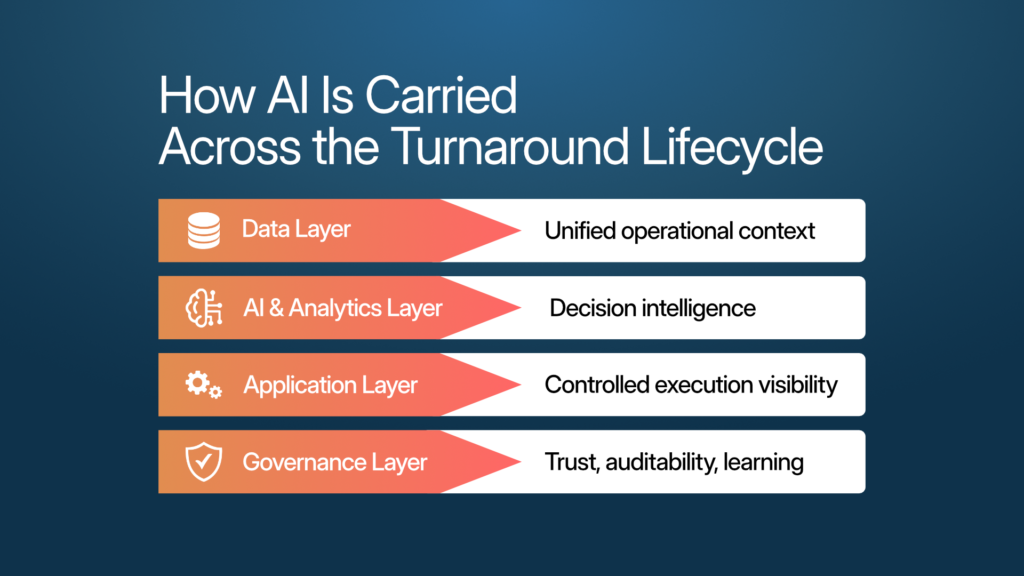
Data layer: connect and contextualise
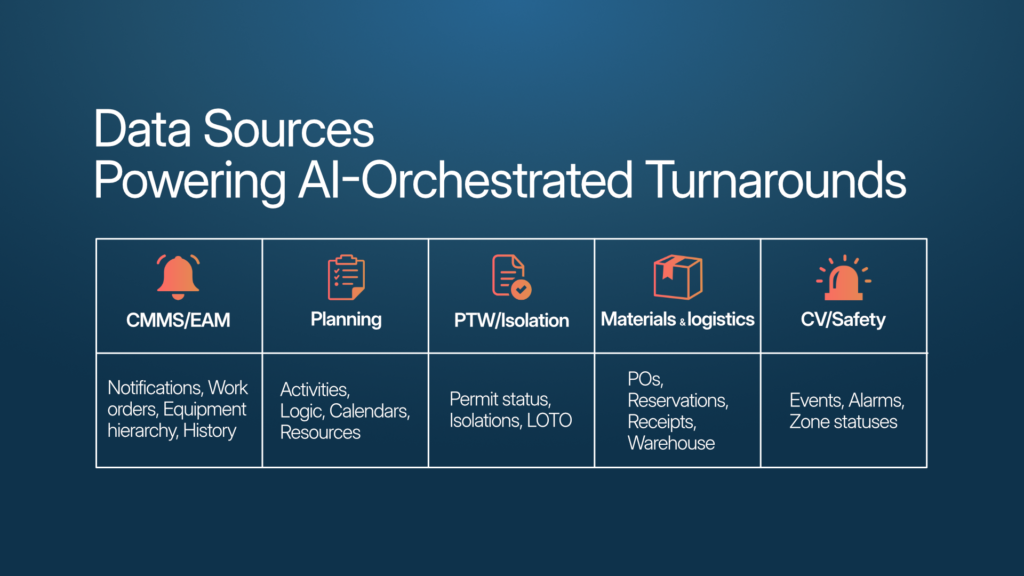
The platform connects to existing systems such as, CMMS/EAM, planning tools, PTW, logistics, safety/CV feeds, mobile apps and builds a unified data model around assets, locations, scopes, workpacks, permits, and milestones.
AI and analytics layer: Models that match real STO decisions
This layer hosts the models that actually change outcomes, including:
- Scope ingestion and lessons learned
- Risk scoring, duration estimation, readiness scoring, constraint prediction
- Progress inference and reforecasting
- Computer vision models for last-mile milestones
Application layer: Orchestration and control tower
This is where value becomes operational. The platform provides the cockpit views across Scope & Risk, Readiness, Execution, Learning and embeds AI insights directly into grids, heatmaps, S-curves, and workflows, with human-in-the-loop validation and overrides.
Governance and feedback loops: Trust, auditability, compounding improvement
The system captures user feedback on AI recommendations and maintains audit trails for critical decisions, supporting safety, compliance, and continuous model improvement across turnaround cycles.
This is the core idea: AI becomes practical when it is carried by an orchestrator that teams already use to run the turnaround.
AI Integration That Works Within Existing Turnaround Systems
In the real world, STO teams don’t have the luxury of replacing systems-of-record. Turnaround Orchestrator is designed to sit above existing tools and integrate through non-disruptive methods such as APIs, OData, flat files, or middleware.
Integration principles
- Non-disruptive: Connect to existing SAP/CMMS, planning tools and PTW without forcing a rip-and-replace.
- Vendor-agnostic: Works across multiple CMMS, planning, and PTW stacks and across different sites/business units.
- Secure by design: Role-based access, audit trails, and integration with corporate identity systems.
Measurable Outcomes of AI-Orchestrated Turnarounds
While results vary by organization, the outcomes are consistent when scope, readiness, execution, and learning operate in sync.
- Reduced TA duration and overruns Tighter scope control and faster response to execution constraints
- Improved Planning and Control Productivity Teams spend less time reconciling data, more time on targeted interventions.
- Compounding learning across cycles Each turnaround strengthens future planning through structured AI feedback.
- Reliability Benefits Beyond Turnaround Events Orchestrator intelligence supports everyday operations and minor outages.
Running Turnarounds with Confidence, Not Guesswork
When AI is embedded properly, it doesn’t feel like a technology project. It shows up as operational clarity:
- Scope lists are cleaner and less political.
- Readiness is quantifiable and transparent.
- Control rooms see a living picture of reality.
- Each turnaround contributes to strengthen future planning.
Turnaround Orchestrator is built on a simple belief: When the entire turnaround is visible, it can be managed more efficiently, transforming turnarounds from high-pressure events into a predictable, continuously improving system.
Take the Next Step Toward Smarter Turnarounds
When orchestration is in place, the operating experience changes. Turnaround managers gain a single, unified view of the event, planners work from historically grounded references, field teams encounter fewer readiness surprises, and leadership sees clear trade-offs and risk-based decisions.
Two practical, low-friction ways to get started:
- Turnaround Readiness Diagnostic:
Baseline Readiness Index + constraint heatmap + critical-path watchlists using the signals approach above. - Offline Scope Validation POC:
Run an IF-score driven scope challenge pack to de-duplicate, prioritize and version scenarios before scope freeze.