
Embed AI across scope, planning, readiness, and execution to reduce surprises, protect the critical path, and improve turnaround predictability without ripping and replacing your existing systems.
Shutdowns and turnarounds remain some of the most demanding events in a heavy-asset lifecycle, compressing years of operational risk into a matter of weeks. High contractor volumes, complex scopes, and tight timelines create direct P&L exposure when delays occur.
Leaders are required to judge scope necessity, assess readiness workpack by workpack, and address recurring delay drivers, often as conditions evolve faster than plans can adapt.
Despite extensive planning, reality often diverges as late-breaking constraints appear, scope grows incrementally, and lessons from prior STOs fail to translate into better outcomes. The way to succeed in this environment depends on moving beyond traditional command-and-control approaches.
The next generation of turnaround leaders will not only rely on heavier documentation or tighter control, but they will run STOs as orchestrated systems of intelligence, where data, AI, and people operate in sync across the turnaround lifecycle.
AI-enabled STOs embed intelligence directly into existing workflows, converting fragmented information into a shared readiness picture, risk-based scope decisions, reliable execution visibility, and structured learning that improves outcomes over time.
Contents In This Blog
Why Digital Tools Alone Don’t Reduce STO Complexity
STOs combine safety-critical work, SIMOPS, regulatory demands, contractor mobilization, and tightly constrained execution. While many organizations have digitized individual activities, the turnaround is rarely managed end to end, leaving teams to coordinate manually when conditions change.
The results in fragmented visibility, late risk discovery, readiness gaps, and learning that fails to carry forward.
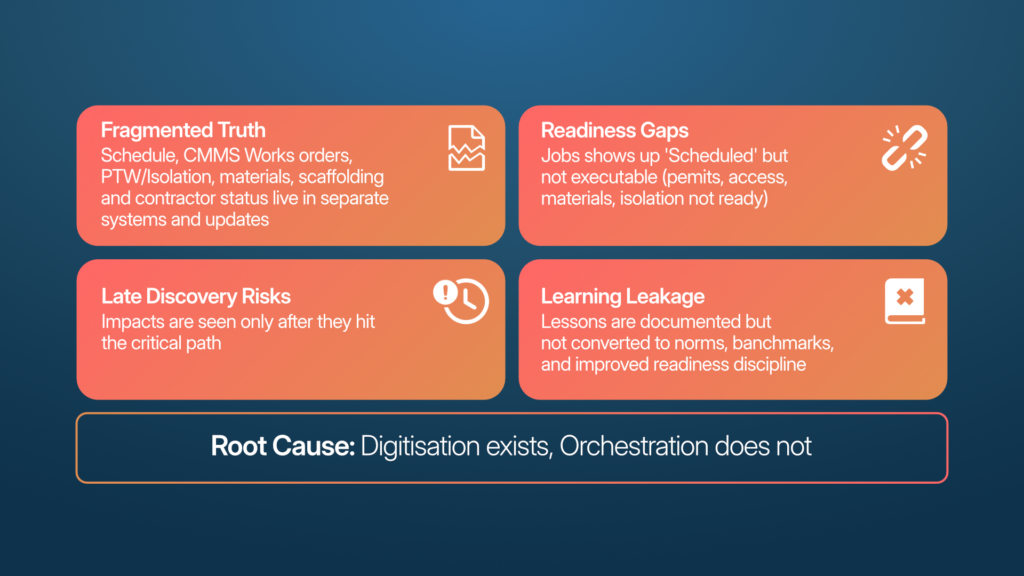
The Shift Toward Orchestrated STO Execution:
Traditional STO management depends on heavy upfront planning, detailed Gantt charts, and manual coordination when execution deviates from plan.
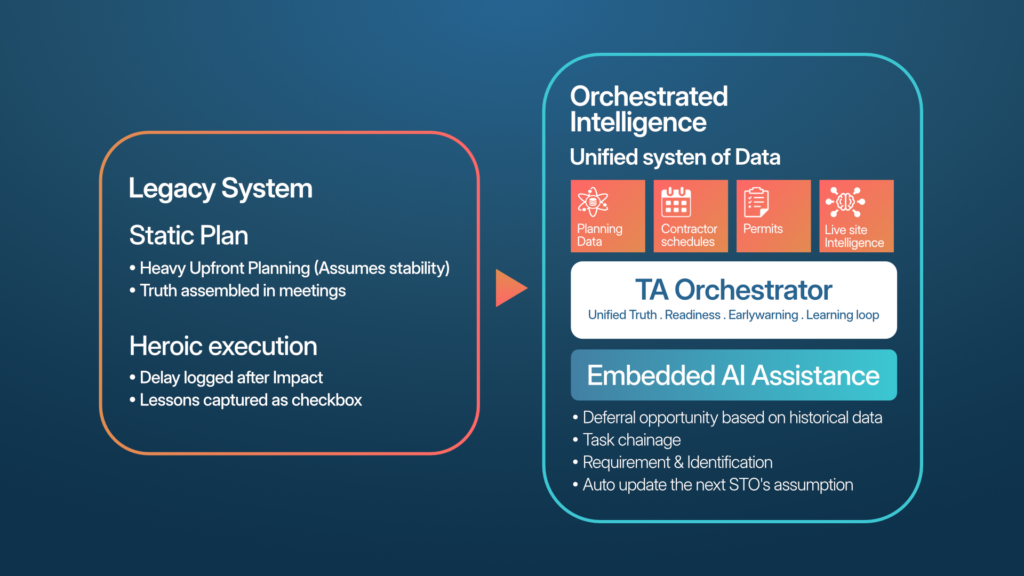
Orchestrated intelligence introduces a shift toward a continuously updated control-tower view, enabling better alignment between plans and execution.
A Turnaround Orchestrator sits above existing systems such as SAP, Maximo, Primavera, and permit tools, aligning data and workflows into a unified operating rhythm across the STO lifecycle.
Embedding Intelligence Across the STO Lifecycle:
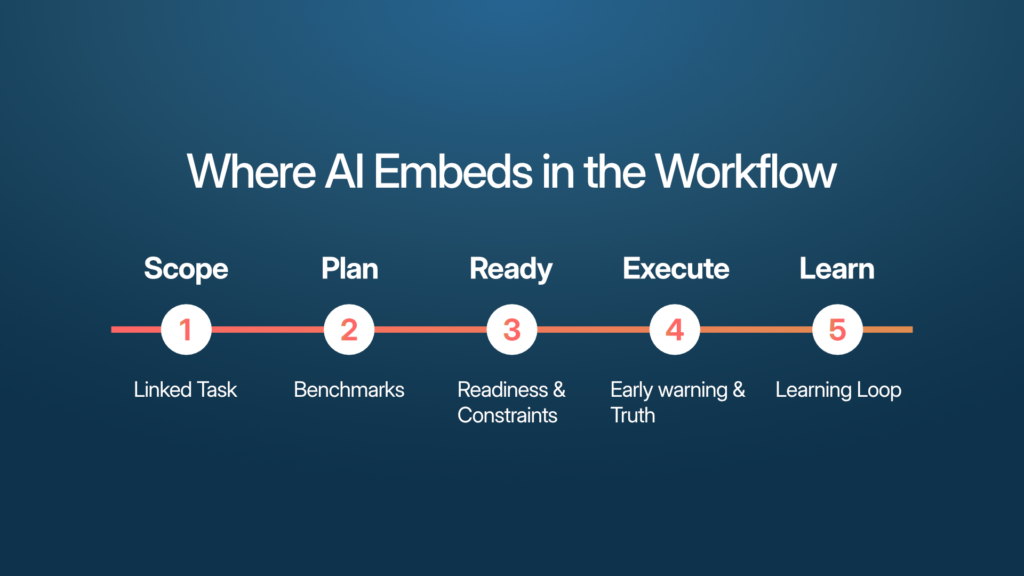
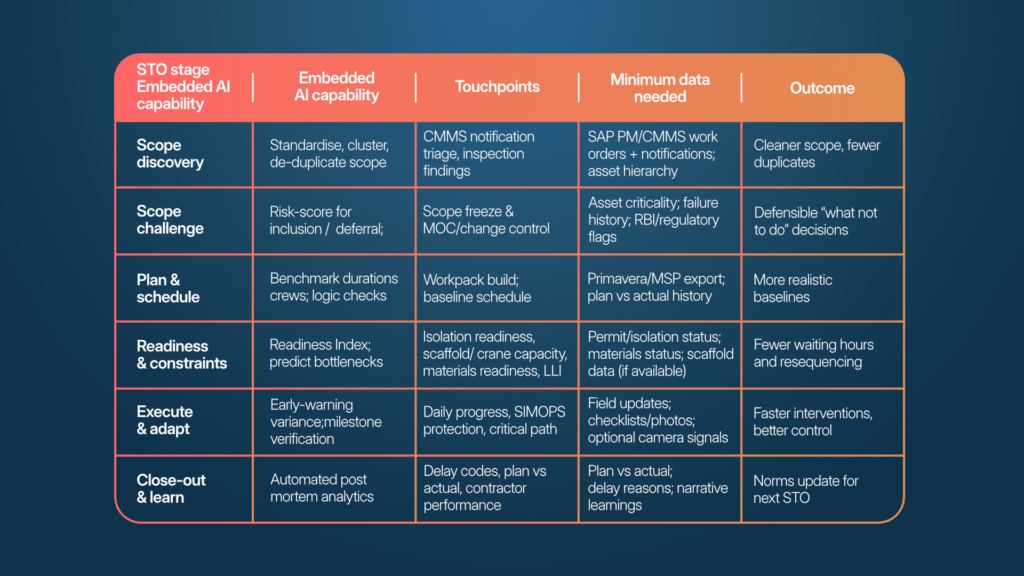
How Embedded Intelligence Works in Practice:
Making AI effective in STOs requires more than isolated models or dashboards. It requires an orchestrator that connects existing systems, contextualizes data, and embeds intelligence directly into the workflows teams already use to plan, prepare, and execute turnarounds.
1) Connect & contextualize
The orchestrator integrates CMMS/EAM systems, planning tools, permit-to-work platforms, logistics systems, computer vision feeds, and field applications. This data is mapped into a unified model covering assets, locations, scopes, workpacks, permits, constraints, and milestones.
2) Analyze & recommend
AI models support scope ingestion and learning reuse, risk scoring, duration estimation, readiness assessment, constraint prediction, progress inference, and last-mile milestone validation using visual evidence.
Make scope clean before you make it big
AI reduces noise by standardizing free-text notifications, clustering duplicates, mapping to unit/system/equipment, and creating a challengeable worklist.
Impact: faster scope reviews, fewer duplicates, clearer scope freeze.
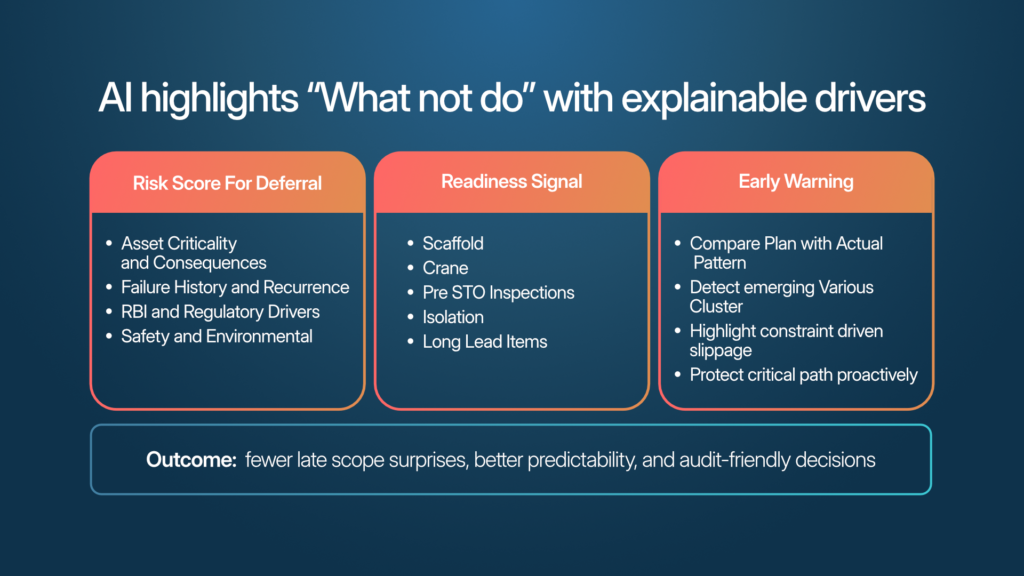
Convert scope debates into risk-based choices:
AI supports deferral decisions with explainable drivers: asset criticality, failure consequences, regulatory flags, historical recurrence and risk patterns supported by scenario comparisons across risk, time, and cost.
Impact: fewer late scope additions, reduced political scope churn.
Build baselines that reflect real constraints:
AI benchmarks task durations, identifies logic conflicts, and highlights congestion risks tied to permits, scaffolding, cranes, and access.
Impact: fewer optimistic baselines that break early in execution.
Readiness discipline:
AI aggregates readiness signals into a workpack-level Readiness Index and predicts bottlenecks such as permit backlogs, scaffold overload, and isolation constraints.
Impact: fewer waiting hours, fewer re-sequences, higher tool-time.
Execution visibility without added bureaucracy:
AI strengthens early warning by comparing plan vs actual patterns, highlighting emerging variance, and optionally validating selected milestones (e.g., scaffold erected, equipment opened, box-up completed) using evidence sources.
Impact: intervene earlier, protect critical path, reduce surprises.
Learning that compounds across STOs:
AI converts plan vs actual and delay narratives into structured learnings, updates norms and benchmarks, and feeds the next STO’s planning assumptions.
Impact: compounding improvement across shutdown cycles.
3) Orchestration With Clear Decision Governance:
Intelligence is surfaced within control-tower views such as grids, heatmaps, and S-curves, with human-in-the-loop oversight. Decisions remain explainable and auditable, supported by closed-loop feedback that builds trust and drives sustained improvement.
Minimum Viable Data to Start
You can start without perfect integration.
Minimum viable (first value):
- SAP PM/CMMS exports (notifications, work orders, history)
- Asset hierarchy (even imperfect)
- Primavera/MSP baseline export
- A subset of readiness signals (materials + PTW/isolation)
High-value add-ons:
- Scaffolding system status
- Materials/warehouse signals beyond GR/IR
8-12 Week Path to First Value
Weeks 0–2: Diagnostic + value chain mapping
- Identify top delay drivers (readiness vs scope vs capacity)
- Choose 1–2 focus units or workfronts
Weeks 4–6: Control tower foundations (lightweight)
- Load exports / read-only connects
- Stand up unified worklist + baseline dashboards
- Create initial Readiness Index
Weeks 6–12: Prove one high-leverage use case
Choose based on your pain point:
- Offline scope optimisation POC (scope freeze support)
- Readiness Index + constraint prediction (reduce waiting hours)
- Evidence-backed milestone verification (execution truth + early warning)
Common Concerns and Practical Responses:
Data quality and consistency
Most organizations operate with fragmented and inconsistent data. The approach focuses on minimum viable inputs, with standardization and de-duplication delivered as part of the solution rather than treated as prerequisites.
Integration and cybersecurity risk
Early phases can be non-invasive, using exports or read-only APIs with role-based access and audit trails. Deeper system write-back is introduced only where it adds clear value.
Operational overhead
The objective is to simplify execution by reducing manual coordination, reconciliation cycles, and reactive follow-ups, enabling teams to address constraints earlier and with greater clarity.
Get Started Without Heavy Disruption:
When orchestration is in place, the STO experience changes meaningfully. TA managers gain a single, reliable operating picture, planners work from historically grounded references, field teams encounter fewer readiness surprises, and leadership can see clear trade-offs and risk-based decisions.
Two practical ways to begin, without launching a large transformation program, include:
- Turnaround Readiness Diagnostic:
Baseline Readiness Index + constraint heatmap + critical-path watchlists using the signals approach above. - Offline Scope Validation POC:
Run an IF-score driven scope challenge pack to de-duplicate, prioritize and version scenarios before scope freeze.
FAQs:
1. What’s the difference between an STO tool and a Turnaround Orchestrator?
STO tools digitize parts of the lifecycle. An orchestrator unifies the operating rhythm end-to-end, across systems, and embeds intelligence into decisions.
2. Do we need to replace SAP or Primavera?
No. The orchestrator typically sits on top of your current systems and connects via exports/APIs in phases.
3. How quickly can we see value?
A well-scoped first release can show value in 8–12 weeks, typically focused on scope optimization or readiness constraints.
4. Can this work across multiple refineries?
Yes. Once the model is established (data mapping + readiness signals + governance), you can scale site-by-site with increasing reuse.