Shutdowns, Turnarounds, and Outages (STOs) are make-or-break moments for industries like oil and gas, petrochemicals, and power generation. With only 30% of STOs meeting time and budget goals, the stakes are high. A new tool is changing the game: AI-driven Impact Factor (IF) Scores. These dynamic metrics are transforming how planners prioritize risks and optimize maintenance, delivering shorter downtimes, better safety, and significant cost savings. Let’s dive into how AI is redefining STO success.
Contents In This Blog
What Are IF Scores and Why Do They Matter?
Impact Factor (IF) Scores are risk assessment metrics that quantify the potential impact of equipment failure across safety, environmental, production, financial, and reputational dimensions. They guide STO planners in focusing on critical assets, like a high-risk reactor, over less urgent tasks, such as routine valve maintenance.
IF Scores are essential because they:
- Streamline Prioritization: Focus efforts on assets with the highest risk.
- Reduce Risks: Prevent safety incidents and regulatory penalties.
- Align Teams: Provide a shared framework for operations, safety, and finance.
However, traditional IF Scores often fall short in today’s fast-moving industrial environments.
The Pitfalls of Static IF Scoring
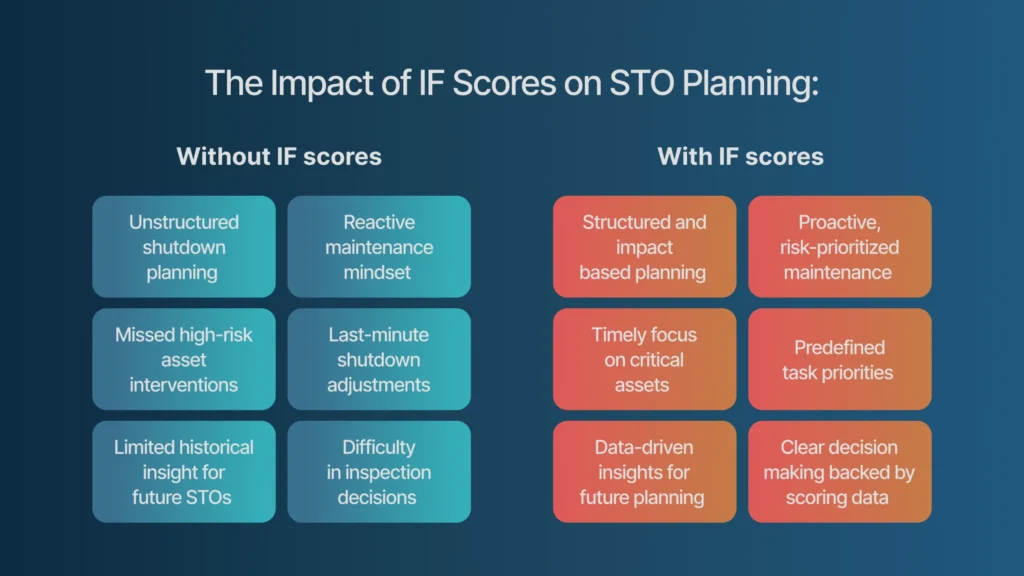
Conventional IF scoring relies on manual processes and static data, creating challenges:
- Stale Data: Scores based on outdated inspections miss emerging issues, like sudden corrosion.
- Time-Intensive: Manual data compilation delays planning and risks errors.
- Inflexibility: Static scores can’t adapt to real-time changes, such as equipment wear or market shifts.
- Narrow Focus: They often overlook external factors like weather or supply chain constraints.
These limitations can lead to misprioritized tasks, extended shutdowns, and unexpected costs. AI-driven IF Scores offer a smarter alternative.
How AI Supercharges IF Scores for STOs
AI transforms IF Scores into dynamic, real-time tools by leveraging cutting-edge technologies. Here’s how:
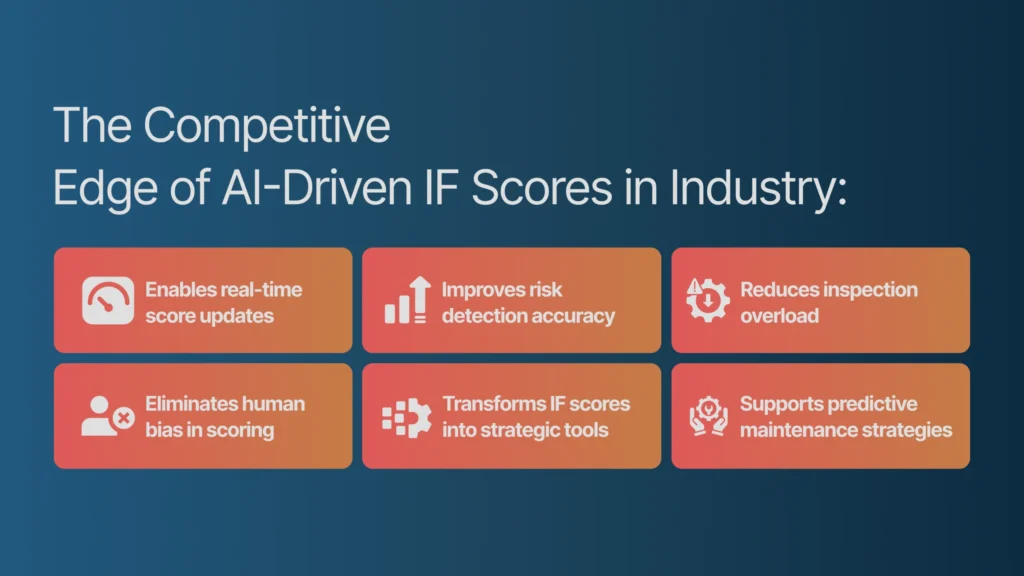
- Seamless Real-Time Data Integration AI pulls live data from IoT sensors, maintenance logs, and external sources like weather forecasts, ensuring IF Scores reflect current conditions. Example: A storage tank’s sensors detect thinning walls. AI instantly updates its IF Score, flagging it for priority inspection during the STO.
- Predictive Risk Detection Machine learning models analyze patterns to predict failures and adjust IF Scores proactively, catching risks that static methods miss. Example: AI spots abnormal vibrations in a compressor, raising its IF Score and prompting preemptive maintenance to avoid a breakdown.
- Optimized Decision-Making AI provides actionable insights, balancing IF Scores with resource availability, schedules, and regulatory needs to create efficient STO plans. Example: When a critical crane is delayed, AI reshuffles tasks to focus on high-IF assets, minimizing downtime without compromising safety.
- Continuous Improvement AI learns from past STOs, refining IF Scores over time to align with facility-specific risks and operational goals.
Proven Benefits of AI-Driven IF Scores
AI-powered IF Scores deliver measurable results:
- Shorter Downtimes: Reduce STO duration by 20–30% through precise prioritization.
- Cost Savings: Cut maintenance costs by 15–25% by focusing on high-impact assets.
- Enhanced Safety: Proactively address risks, protecting workers and communities.
- Better Compliance: Real-time monitoring ensures adherence to regulations.
- Faster Planning: Slash planning cycles with automated data integration.
The Future of STO Planning Is Here
AI-driven IF Scores are no longer a luxury – they’re a necessity for staying competitive in high-stakes industries. By turning static risk metrics into dynamic, actionable insights, AI empowers planners to execute STOs with precision, efficiency, and confidence.
Want to Unlock the Full Potential of AI for Your STOs?
Our whitepaper, Mastering Shutdowns, Turnarounds, and Outages with Dynamic IF Scores, dives deeper into AI’s transformative role, with case studies, technical insights, and implementation strategies.