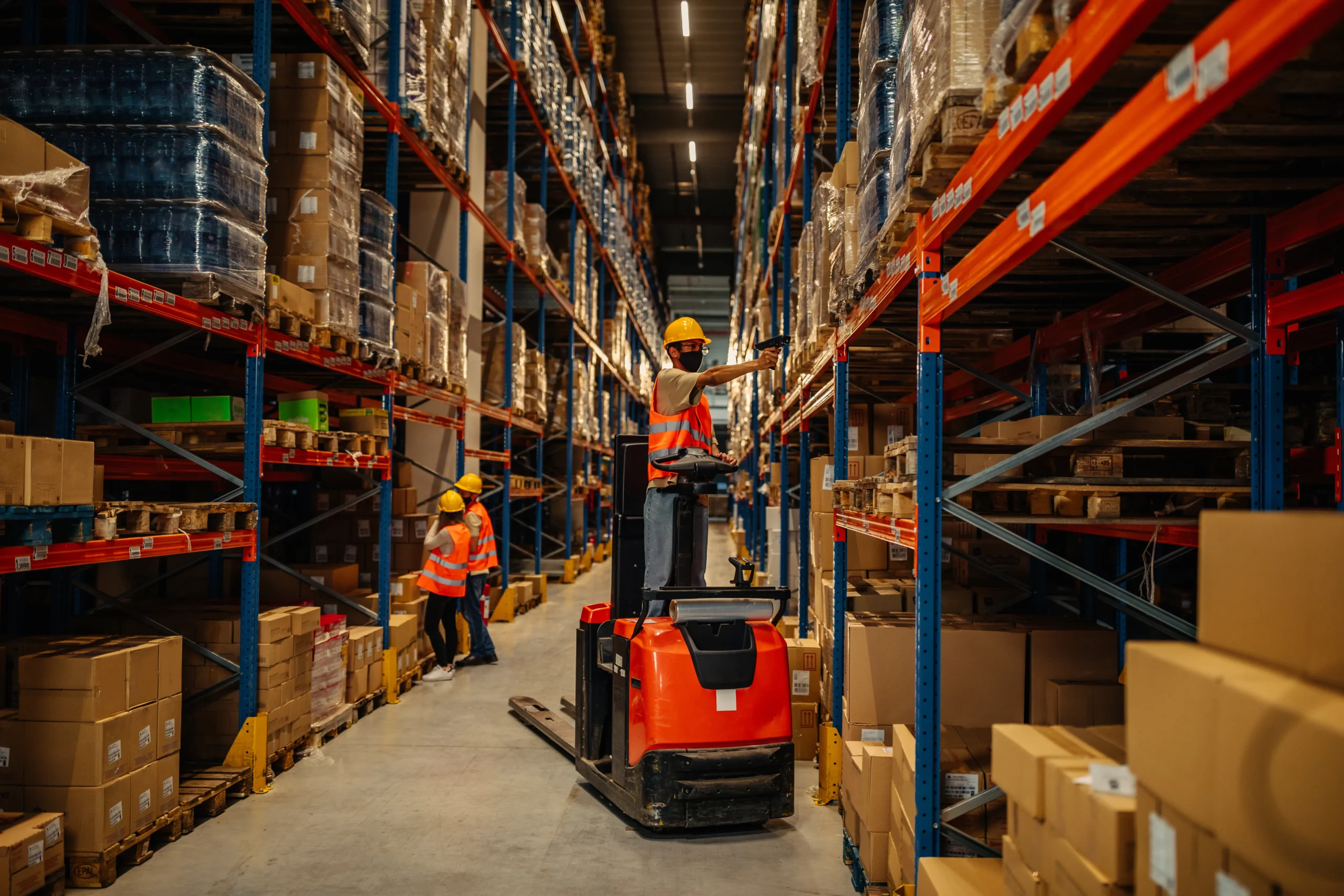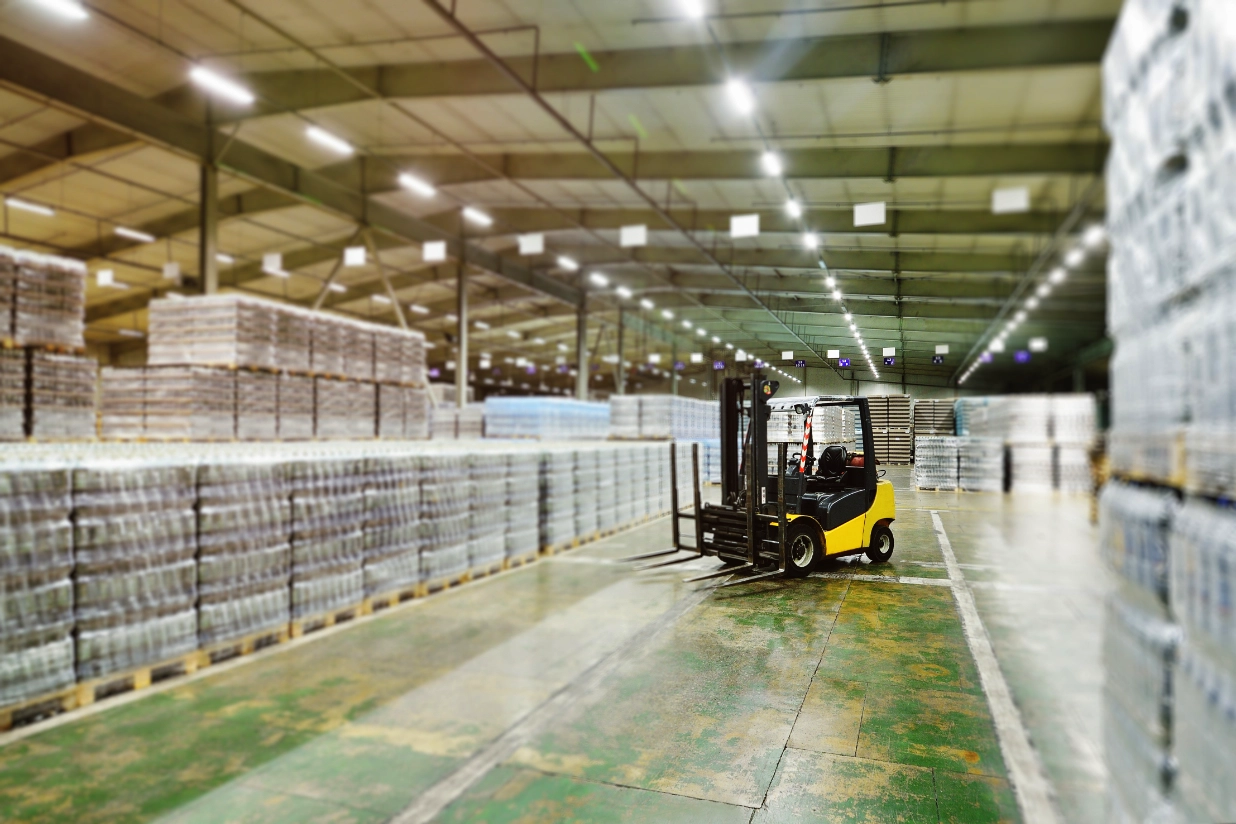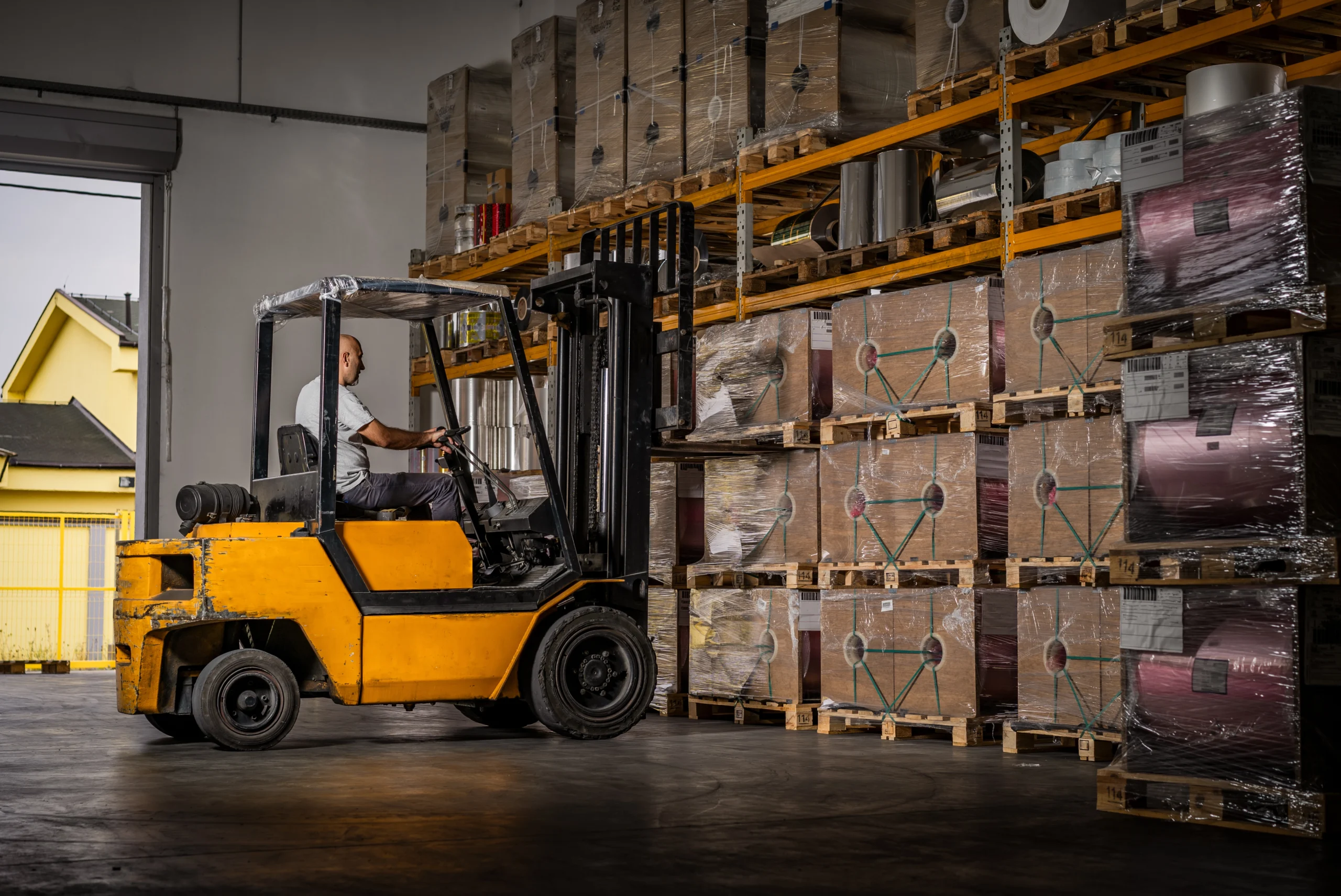
Forklift incidents are rarely caused by a single “bad moment”. They are usually the predictable outcome of blind spots, mixed traffic, and split-second decisions in busy aisles, docks, and crossings. Forklifts are high-risk vehicles with significant blind spots especially when carrying loads and shared workspaces increase collision risk due to unpredictable human movement.
That’s why effective prevention cannot rely only on static controls like markings, mirrors, or signage. Prevention has to work in-motion, in the exact moment visibility breaks down. The most effective modern approaches are integrated on the forklift and evaluate risk using moving safety zones around the forklift, a vehicle-centric safety envelope that travels with the hazard.
This guide explains why blind spots persist, where collisions cluster, and what to prioritize if your goal is to reduce forklift accidents and strengthen warehouse pedestrian safety.
Contents In This Blog
Why Forklift Blind Spots Persist
Forklifts are designed to move loads efficiently, not to maximize all-direction visibility. In practice, floor design, layout, and several factors combine to compound the issue.
1) The mast + load are built-in visibility blockers
The mast, carriage, and the load itself obstruct sight lines especially with bulky pallets, oversized cartons, or high stacks. Even when operators compensate by traveling in reverse or leaning, the visibility problem doesn’t disappear; it shifts.
2) Turning creates rear-swing risk outside the operator’s focus
Forklifts steer from the rear axle. Tight turns can produce rear swing that clips pedestrians, racks, or other vehicles often outside the operator’s immediate field of view.
3) Warehouses and plants create “occlusion geometry”
The environment introduces repeatable visibility constraints:
- Rack ends at cross-aisle intersections
- Dock thresholds, trailers, and staging clutter
- Temporary pallets intruding into lanes
- Doorways/transitions with glare or low light
These aren’t exceptions. They are normal operating conditions.
4) Human factors amplify the gap
Even with training, people adapt to keep flow moving. If the floor forces shortcuts, risk normalizes until a collision forces a reset.
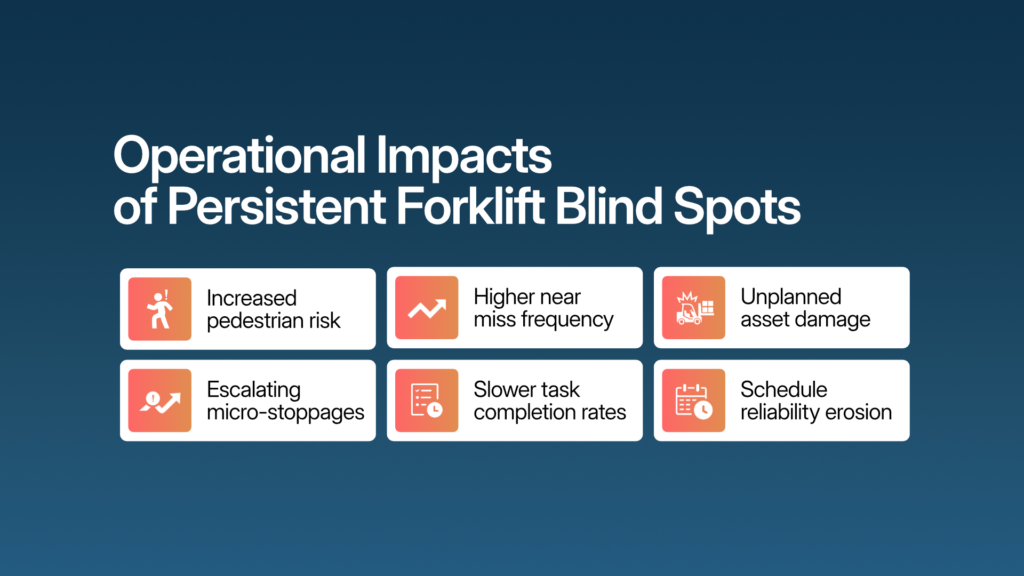
Where Collisions and Near-Misses Usually Cluster
- Cross-aisle intersections: Traffic converges, racks occlude sight lines, and pedestrians cut across. The risk spike is predictable but operators often arrive with limited time to scan.
- Loading bays and dock approaches: Congestion rises with inbound/outbound peaks. Trailers, dock plates, and staging pallets create clutter and blind zones.
- Pick aisles with pedestrian activity: Shared aisles create unpredictable pedestrian movement. People step out from behind racks, carts, or pallets and forklift operator often gets limited advance warning, even at low speeds.
- Doorways and transitions: Moving between indoor/outdoor zones or between lighting conditions reduces visibility for a few critical seconds. The “I didn’t see them” pattern is common here.
- Battery charging, maintenance, and marshalling areas: These zones often have multiple vehicle types and non-standard movement patterns, increasing the chance of unexpected interactions.
Why Traditional Controls Often Fall Short
Many facilities deploy a mix of training, mirrors, floor markings, horns, blue spot lights, and proximity alarms. These measures help but they also have limitations.
- Passive controls - Depend on perfect behaviour every time
- Generic alarms - Can create nuisance triggers and “alarm fatigue”
- Lack of directional context - Operators don’t know where the danger is
Mirrors and markings are passive
They rely on consistent behavior from everyone, every time. They don’t adapt to dynamic congestion or unexpected movement.
Audible alarms can become background noise
Beepers, horns, and general alerts can fade into the operational soundscape, especially in high-activity environments.
Basic proximity sensors can cause alarm fatigue
A typical forklift proximity warning system may detect “something nearby,” but it often cannot tell:
- Is it a person or a pallet?
- Is it moving toward the forklift or away?
- Is it in the path of travel or safely outside it?
When alerts trigger too frequently or without context, operators stop trusting them. That is the core mechanism behind alarm fatigue: more alerts, less attention.
The solution is not “more alarms.” It’s more actionable awareness.
What a Modern Forklift Blind Spot Solution Does Differently
A forklift blind spot solution must improve safety in the moment of risk. A forklift-integrated forklift collision avoidance system (FCAS) is designed to do that through signal quality, context, and escalation.
This is where a forklift collision avoidance system (FCAS) based on vision and edge AI changes the equation.
1) It detects and classifies objects – not just “something nearby”
A recurring issue with basic alarms is a high rate of false positives, which leads to operator alarm fatigue. Instead of triggering on anything within a radius, a vision-based system can identify whether the object is:
- a pedestrian
- another vehicle
- an obstacle (rack edge, pallet, barrier)
That classification reduces nuisance alerts and preserves operator trust, which is critical for real-world adoption.
2) It provides directional context
Operators respond better when they understand where the risk is. Generic beeps do not answer: “Where the danger is?” or “How urgently they need to react”
Systems that present a clear “radar-style” view (front/back/side) help operators instantly locate the risk and take the right action faster than generalized beeps.
3) It uses vehicle-centric safety zones (relative to the forklift)
This is the most important operational point: effective systems evaluate risk using zones around the forklift (front/rear/side), so the safety envelope moves with the vehicle.
FCAS supports configurable safety zones (green/amber/red) for calibration and escalation. The zones can be tuned to operating contexts (tight aisles vs docks), but they remain forklift-centered, which is what makes them relevant during turning, reversing, and approach scenarios.
4) It runs on the forklift (edge-first) for low-latency response
FCAS uses a ruggedized on-device edge AI foundation, supporting low-latency, Wi-Fi independent operation. For prevention, that matters: real-time response must not depend on perfect connectivity.
5) It supports retrofit deployment across mixed fleets
Many sites operate mixed forklift models and ages. A retrofit forklift safety system can be deployed across existing equipment, avoiding delays tied to OEM upgrades or fleet replacement timelines.
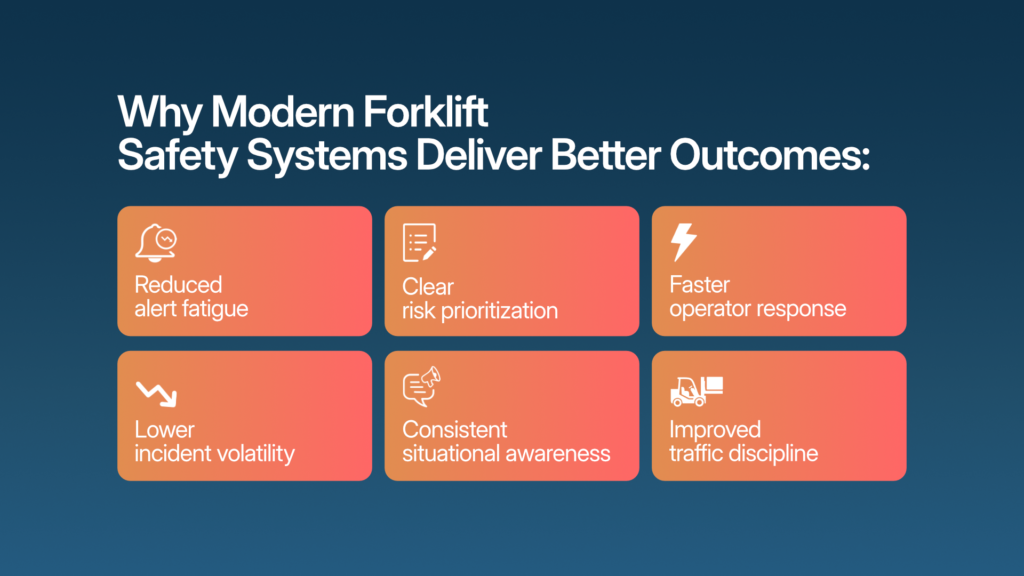
What “Reducing Forklift Accidents” Looks Like Operationally
Avoid measuring success only by whether the system “detects.” Measure whether it produces actionable signals and reduces near-miss exposure in high-risk moments:
- Actionable Alerts: Alerts increasingly prompt correct action rather than unnecessary operator responses.
- Operator Trust: Operators engage with alerts because they add clarity, not distraction.
- Near-Miss Indicators: Near-miss proxies decline in site-defined, high-risk operational zones.
- Damage Reduction: Fewer impacts on racks, docks, and pallets over time.
- Hotspot Exposure: Near-miss frequency drops consistently in previously identified collision hotspots.
- Traffic Behavior: Reduced panic braking reflects smoother flow and improved situational awareness.
The real win is not just fewer incidents. It is predictable, repeatable prevention in the exact moments when humans are most vulnerable to blind spots.
A Quick Checklist to Reduce Forklift Accidents from Blind Spots
Use this as a starting audit:
- Are pedestrians and forklifts sharing aisles without controlled crossings?
- Are current proximity alerts frequently ignored due to nuisance triggers?
- Are dock approaches congested with staging pallets or mixed traffic?
- Is your fleet mixed enough that OEM-only options won’t scale quickly?
- Do operators have directional visibility support (not just audible alerts)?
If you answered “yes” to more than two, a modern collision avoidance approach is worth evaluating.
If you are evaluating a forklift collision avoidance system or forklift pedestrian detection system, begin with a short risk scan: identify your top collision-prone zones, and run a small pilot (2–5 forklifts) focused on how zones around the forklift behave during turning, reversing, and dock approaches.
FAQs:
1. What is the best way to reduce forklift accidents in a warehouse?
Start with hotspot mapping (docks, intersections, shared aisles) and implement forklift-integrated controls that work in the moment of risk especially solutions that use vehicle-centric zones around the forklift, directional context, and escalation.
2. Why do proximity alarms get ignored?
High nuisance alerts and lack of directional context lead to alarm fatigue so, operators stop trusting alerts that don’t match real risk.
3. Do forklift proximity warning systems reduce accidents?
They can, but performance depends on false alert rates and operator trust. Systems that only detect “presence” often cause alarm fatigue. A context-aware approach that distinguishes pedestrians from obstacles and provides directional guidance is typically more effective.
4. Is a retrofit forklift safety system practical for mixed fleets?
Yes, retrofit solutions are commonly used when fleets include multiple models and ages. The key is a deployment playbook that includes calibration, maintenance SOPs, and operator onboarding