
If your security team is overwhelmed by constant motion detection notifications, the issue is already clear: more alerts do not automatically translate into stronger security. In industrial sites, where perimeters are vast and staffing is limited, traditional motion detection generates a steady stream of low-quality alarms that operators gradually learn to ignore. The system stays active, but the organization’s risk posture does not improve.
This condition is called alarm fatigue. It is one of the fastest ways for a security operation to become reactive, inconsistent, and exposed during audits, particularly at night when false triggers increase and operator attention is already under pressure.
Contents In This Blog
What is Alarm Fatigue in Security Operations?
Alarm fatigue occurs when operators are exposed to a high volume of alerts, most of which are irrelevant, leading to gradual desensitization. Over time, clear patterns emerge:
- Response slows down
- Genuine threats are overlooked
- Operators create workarounds (muting alerts, ignoring certain cameras or delay reviews)
In industrial security, alarm fatigue is not a human failure. It is a system design failure. Motion-based alerts are optimized for detection volume rather than detection quality.
Why Motion Detection Alerts Break Down In Industrial Settings
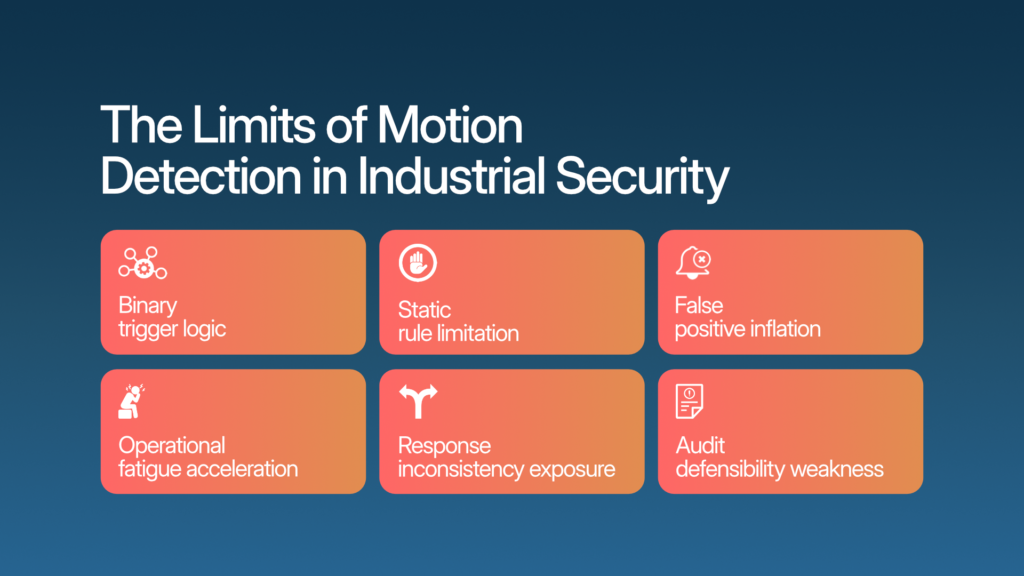
Motion detection is a blunt mechanism. It reacts to movement, not context. In industrial environments, this results in persistent alert noise.
1) Industrial conditions that naturally trigger motion
- Moving shadows, flares, steam, reflections, headlights
- Wind-driven vegetation, dust, rain, insects, birds, wildlife
- Vibration and camera jitter
- Night conditions that amplify contrast shifts
This explains why traditional surveillance struggles as scale increases. Too many cameras, limited operator capacity, and a high volume of low-quality alerts create significant operational burden, particularly during night shifts.
2) Scale multiplies noise
False alerts from a single camera may be tolerable. Across large perimeters with dozens or hundreds of cameras, the same issue becomes a source of continuous operational disruption.
3) Detection is not response
Even when potential threats are identified, many sites lack a governed response loop. Escalation and documentation vary by shift, supervisor, and urgency. In practice, events may be observed, but they are not handled consistently.
The Hidden Costs of Alarm Fatigue
Alarm fatigue introduces compounding costs that security teams often fail to quantify until a serious incident brings them to the surface:
Operational cost
- Time wasted triaging false alerts
- Dispatch overhead and fatigue
- Lower morale and higher turnover in SOC/control room teams
Risk cost
- Reduced attention for truly high-severity events
- Slow response time when a real threat occurs
Compliance and audit exposure
When incident handling is inconsistent, you often lack:
- A complete event trail
- Proof of escalation
- Evidence retention policies
- ‘Detection → escalation → closure’ traceability
What Effective Industrial Security Looks Like: Verified Events and Governed Response
Industrial security monitoring improves when you shift from motion-triggered alerts to context-verified events.
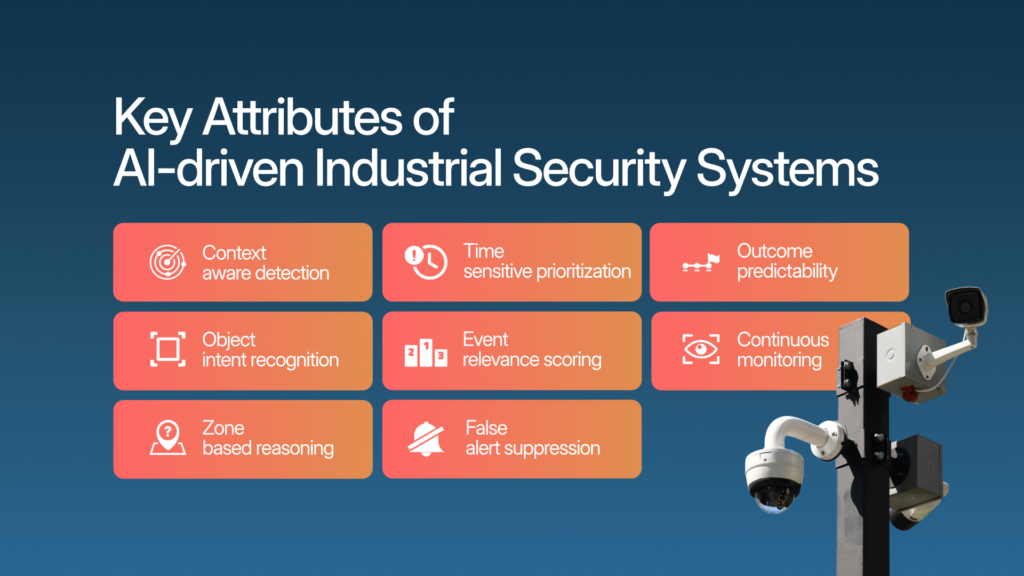
A modern AI security layer should do four things well:
- Detect with context: Intrusion, restricted access, loitering, vehicle anomalies
- Escalate intelligently: Notify via mobile/SMS/WhatsApp and route using escalation matrices by zone/severity/time
- Prove what happened: Evidence capture, logging, and retention policies
- Ensure the system is actually “on”: 24×7 camera uptime monitoring to detect downtime and feed interruptions
When combined, these capabilities reduce alert noise and rebuild operator trust, often achieving up to 90% fewer false alarms compared to traditional motion detection approaches.
How AI Reduces False Alarms: The Mechanism
False alarms decrease when a security system can determine what is actually occurring, rather than simply detecting movement.
AI video analytics reduces false alerts by:
- Classifying objects and intent (person/vehicle/loitering vs irrelevant motion)
- Applying zone context (restricted process area vs public corridor)
- Prioritizing by severity and time window (night perimeter breach > daytime movement)
- Supporting thermal cameras for night precision where required
A Practical Playbook to Eliminate Alarm Fatigue Using Existing CCTV
Below is a field-ready approach to move from noisy alerts to trusted events.
Step 1: Define your threat model per zone
Start with 6–10 scenarios that matter, mapped to zones:
- Perimeter intrusion
- Restricted zone access
- Loitering near critical assets
- Vehicle entry into process areas
- Tamper/sabotage indicators
- Pipeline RoW encroachment/excavation indicators
The objective is not to detect everything. It is to detect what matters.
Step 2: Implement escalation matrices and make them auditable
Hard-code routing rules:
- Zone → severity → responder
- Time window (night vs day)
- Escalation ladder if not acknowledged
This is what effective escalation and response should enable, with matrices defined by zone, severity, and time window.
Step 3: Instrument evidence and closure
If the event is real, you need a complete package:
- Live stream + playback retrieval for investigations
- Automated logging and retention policies
- Audit-ready traceability from detection to closure
Many security programs struggle here, failing not because of missed detection, but because documentation is incomplete.
Step 4: Add camera uptime monitoring
Alarm fatigue is often attributed to excessive alerts, but an equally serious risk is false confidence caused by cameras that are down, misaligned, or frozen.
24×7 camera uptime monitoring should:
- Detect downtime/feed interruptions
- Maintain readiness
- Support operational reporting and audits
Step 5: Deploy in a way that matches OT reality
Industrial sites often need flexibility: cloud, on-prem, or edge deployment depending on connectivity and governance constraints . The key is to leverage existing CCTV and scale patterns across facilities.
A typical onboarding can be as fast as ~2 weeks using existing CCTV infrastructure where prerequisites are met. This matters because alarm fatigue is an operational issue, not a 12-month transformation program.
Quick Self-Assessment: Do you have alarm fatigue?
Answering yes to any 3 of these indicators strongly suggests alarm fatigue:
- Operators ignore alerts from specific cameras or zones
- “Motion detected” is your dominant alert type
- Night shifts receive significantly more alerts than day shifts
- Incident response varies by supervisor or shift
- Investigations rely on manual search rather than packaged evidence
- You cannot easily prove detection → escalation → closure
What to do next
If your CCTV system is generating noise, the objective is straightforward:
Minimize false alarms, improve response speed, and ensure incidents are audit-ready without the need to replace current camera infrastructure.