
Industrial perimeters differ fundamentally from commercial buildings. They span larger footprints, operate in harsher environments, and face challenges that are rarely about camera coverage. The real gaps emerge from scale, staffing constraints, and inconsistent response. Traditional surveillance models struggle under these conditions, particularly when large camera networks are monitored by limited teams and flooded with low-quality alerts, most notably during night operations.
A practical perimeter security program needs more than detection. It needs a threat model that translates into:
- Zone-based rules
- Severity and escalation matrices
- Audit-ready evidence packs
- Readiness monitoring (camera uptime)
Your system needs to detect anomalies, escalate with matrices by zone/severity/time , maintain 24×7 camera uptime and generate a complete evidence trail with audit-ready closure.
Contents In This Blog
A Buyer Readiness Checklist Before You Pilot
You are perimeter-ready, if you can confidently answer yes to most of the following:
- We have an explicit perimeter threat model by asset type (plant, terminal, RoW).
- Perimeter is segmented into zones with different criticality.
- We have defined critical perimeter threats (personnel access, vehicle intrusion, tampering).
- Alerts route via escalation matrices by zone/severity/time window.
- Each incident produces an evidence pack and a closure disposition.
- We monitor camera uptime and feed interruptions so the perimeter doesn’t quietly go blind.
If you cannot answer these today, your perimeter risk is probably higher than your dashboard suggests.
Step 1: Define the Industrial Perimeter Threat Model
A strong threat model is concise and focused. It prioritizes a limited set of high-risk scenarios and maps them directly to perimeter zones and response playbooks.
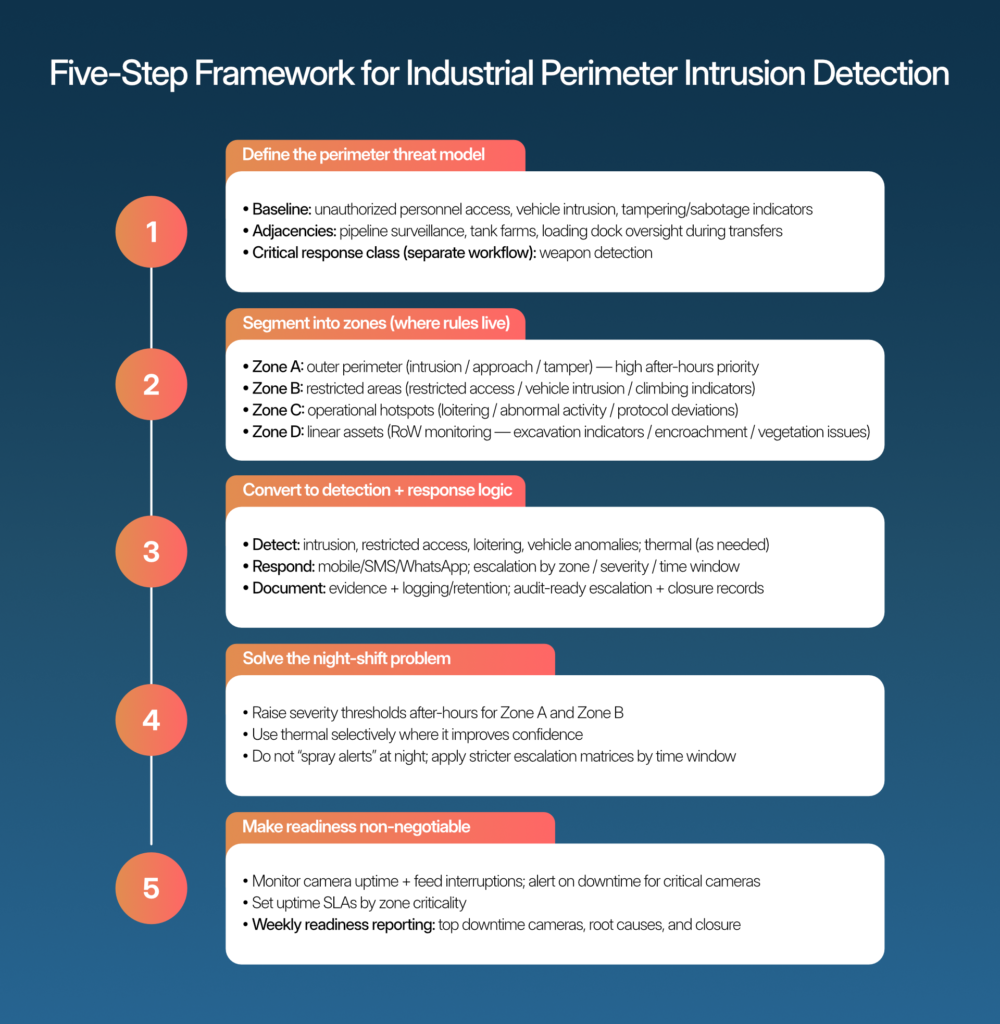
1) Critical Perimeter Threats: Baseline Coverage
- Unauthorized personnel access
- Vehicle intrusion in restricted process areas
- Equipment tampering and sabotage indicators
2) Perimeter Adjacencies Commonly Missed in Industrial Sites:
Industrial perimeters extend beyond physical boundary lines and include adjacent exposures that can create significant risk:
- Pipeline
- Tank farm
- Loading dock oversight during transfers
3) Emergency Signals Requiring Dedicated Response
These signals must be isolated from routine perimeter alerts and managed as high-severity incidents with a separate response path.
- Weapon Detection
Step 2: Segment the Perimeter into Zones
Industrial sites need zoning because perimeter risk varies significantly across locations. A minimum viable zoning model ensures the structure needed to apply consistent detection and escalation logic.
Zone A – Outer Perimeter With Rapid Response Priority
Examples: Fence line, Boundary wall, Entry roads, Long corridors.
Primary events: Intrusion, Vehicle approach, Tampering patterns.
Priority: High after-hours.
Zone B – Restricted Areas With Elevated Severity Controls
Examples: Process units, Tank farms, Substations, Control rooms.
Primary events: Restricted access, Vehicle intrusion, Climbing indicators.
Zone C – Operational Hotspots Requiring Context-Aware Detection
Examples: Docks, Yards, Terminals, Contractor gathering areas.
Primary events: Loitering, Abnormal crowding, Transfer protocol deviations.
Zone D – Linear Assets and RoW Monitoring
Examples: Pipeline right-of-way segments, Remote corridors.
Primary events: Excavation indicators, Encroachment, Vegetation issues.
Step 3: Convert the Threat Model into Detection and Response Logic
Perimeter security programs fail when they stop at detection alone. A practical design applies a structured operating model that connects detect → respond → document into a single workflow.
Detection Scope: Minimum Viable Coverage
The baseline for instant threat detection should focus on a concise set of high-relevance signals:
- Intrusion, Restricted access, Loitering, Vehicle anomalies
- Contextual classification to reduce false alarms
- Thermal support for improved night detection where required
Response Logic for Routing and Dispatch
Escalation logic must be embedded directly into the system architecture:
- Notify via mobile app, SMS, or WhatsApp
- Escalation matrices by zone, severity, and time window
- Integrate into existing security team protocols
This approach enables coordinated emergency response through integration with security teams, control systems, and emergency protocols for high-severity incidents.
Evidence and closure: How to make it audit-ready
A complete evidence trail should be treated as mandatory rather than optional:
- Event evidence (live stream, playback, retrieval)
- Automated logging and retention policies
- Audit-ready detection → escalation → closure records
This distinction separates isolated alarms from structured security operations.
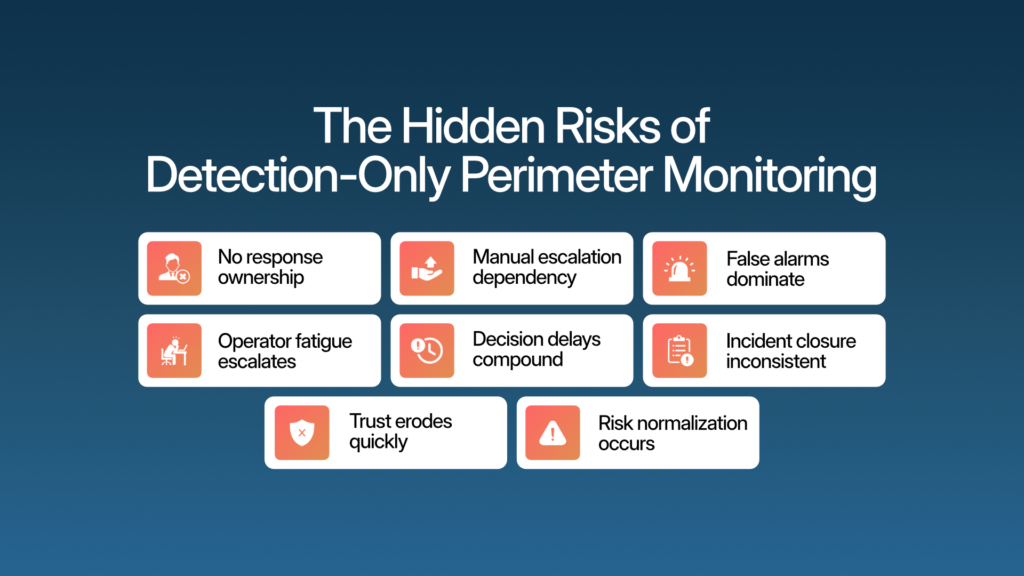
Step 4: Solve the Night-Shift Perimeter Risk
Night shifts introduce the highest likelihood of failure in perimeter monitoring, driven by fatigue and limited visual clarity.
A practical approach:
- Raise severity thresholds after-hours for Zone A and Zone B.
- Use thermal selectively where it improves confidence.
- Do not “spray alerts” at night. Use stricter escalation matrices by time window.
Step 5: Make Perimeter Readiness Non-Negotiable
Camera availability is a foundational requirement for perimeter security. When uptime is not actively monitored, perimeter risk increases without immediate visibility.
If you do nothing else, implement:
- Uptime SLAs by zone criticality
- Downtime alerting for critical cameras
- Weekly readiness reporting (top downtime cameras, root causes, closure)
FAQs
1. What is perimeter intrusion detection for industrial sites?
It is the detection of unauthorized personnel or vehicle access along outer boundaries and critical zones, typically using CCTV analytics rather than basic motion alerts.
2. Which perimeter threats should industrial sites prioritize first?
Start with unauthorized personnel access, vehicle intrusion in restricted areas, and equipment tampering indicators.
3. How do you reduce false alarms in perimeter monitoring?
Use context classification (not motion-only), zone-based rules, and time-window severity thresholds.
4. What is the role of escalation matrices in perimeter security?
They define who is notified, when, and via what channel by zone, severity, and time window so, response is consistent across shifts.
5. Why is an evidence trail important for perimeter incidents?
Because investigations and audits require proof: video playback/retrieval, logging, retention, and records from detection through closure.
6. How do you handle night perimeter monitoring effectively?
Tighten night rules, use thermal where it improves confidence, and avoid alert overload (alarm fatigue).
7. Can perimeter intrusion detection work with existing CCTV/VMS?
Our system is designed to leverage existing CCTV and work with common IP camera/VMS environments. Request a diagnostic to find out compatibility with your infrastructure.
8. What should be included in a perimeter pilot?
2–3 zones, 4–6 event types, escalation rules, evidence packs, and uptime reporting with measurable response and false-alarm KPIs.