
Most industrial sites do not fail due to an inability to detect threats. Failures occur when detection does not consistently translate into action. Even when risks are visible, many teams operate without a governed response loop, resulting in inconsistent escalation, incomplete documentation, and uneven closure across shifts and locations.
This is why AI Security Monitoring must function as a modern operational layer that detects, escalates, and documents incidents systematically using your existing CCTV infrastructure, to enable governed security operations rather than standalone video analytics.
Contents In This Blog
What is a Governed Response Loop?
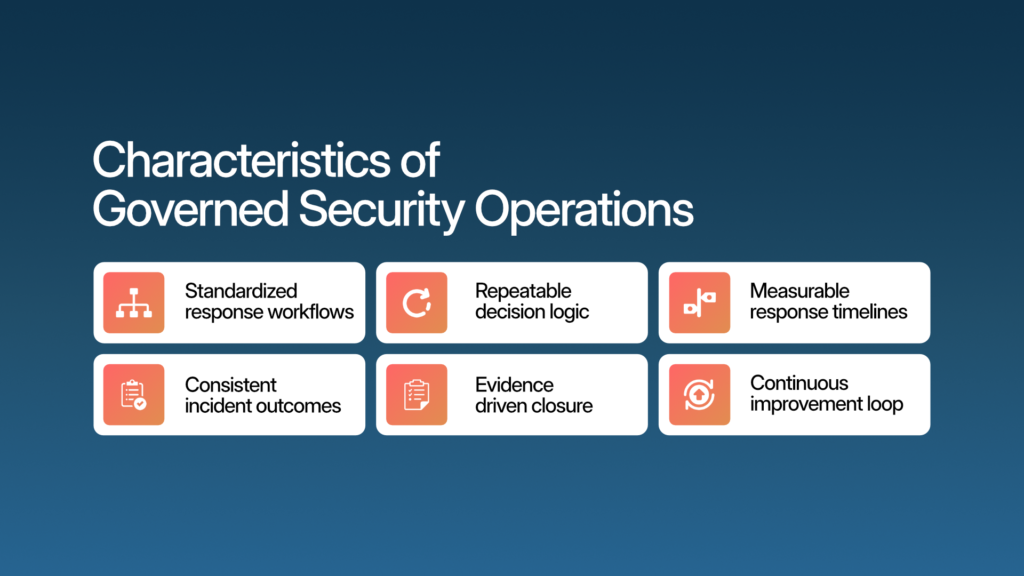
A governed response loop is a standardized operating system for managing security incidents across industrial environments.
Detect → Verify → Notify → Triage → Dispatch → Document → Close → Improve
It ensures each event is managed with:
- the right level of urgency based on severity
- the right responder through defined routing
- the right timeline governed by SLAs
- the right proof through a complete evidence pack
- the right outcome with closure and learnings
If your current process depends on “who is on shift” or “who noticed the alert,” then, the operation lacks a governed response loop and instead relies on a best effort routine.
Why Alerting Fails at Scale and Governance Becomes Essential
Industrial sites present operating conditions that expose the limitations of alert-centric security:
- Large perimeters and restricted operational zones
- Constrained control room attention
- Operational variance across day and night shifts
- Response coordination across guards, supervisors, and site leadership
In this setting, motion alerts and ad hoc phone calls quickly lose effectiveness as volume increases. Governance introduces a repeatable response system through escalation matrices structured by zone, severity, and time window.
The 4 Building Blocks of a Governed Response Loop
1) A clear event taxonomy
Begin with a focused set of security events and expand over time. Common industrial baselines include:
- Intrusion, restricted access, loitering, vehicle anomalies
- Equipment tampering indicators
- Process-specific threats like pipeline encroachment or tank farm climbing
Keep classifications operational. If operators cannot classify events quickly, response will degrade.
2) An escalation matrix
Your escalation matrix should be explicit and programmable:
- Zone (perimeter, restricted process area, dock, tank farm, RoW)
- Severity (High / Medium / Low)
- Time window (day shift / night shift / critical operations window)
- Notification route (mobile app, SMS, WhatsApp)
- Fallback escalation (if no acknowledgement)
The matrix must operate as an embedded workflow rule, not a static reference.
Practical severity example:
- High: Active perimeter breach, Vehicle intrusion in restricted process area
- Medium: Loitering near sensitive entry points, Suspicious activity near docks
- Low: Non-critical anomalies logged for review
3) SLAs for acknowledge, dispatch, and closure
Governance requires timers, not intentions. Define three SLAs:
- Acknowledge SLA: How fast someone confirms they saw the alert
- Dispatch SLA: How fast a responder is mobilised
- Closure SLA: How fast the event is resolved with a disposition
If an event is not acknowledged within the window, it must automatically escalate to the next tier. Without this, your workflow is just a notification.
4) Automatic evidence + Audit-ready closure
Industrial security requires verifiable proof, not verbal confirmation.
A complete evidence trail must include event evidence such as live stream, playback, and retrieval, supported by automated logging, retention policies, and audit-ready records of detection → escalation → closure.
Minimum evidence pack per incident:
- Event summary (zone, type, severity, timestamp)
- Video package (pre-roll, event clip, post-roll)
- Escalation log (who was notified, when, acknowledgement)
- Action notes (dispatch, on-ground verification)
- Closure disposition (true incident, false alarm, needs investigation, preventive action)
This is the difference between alerts and security operations.
How to Implement a Governed Response Loop in 2 to 4 Weeks
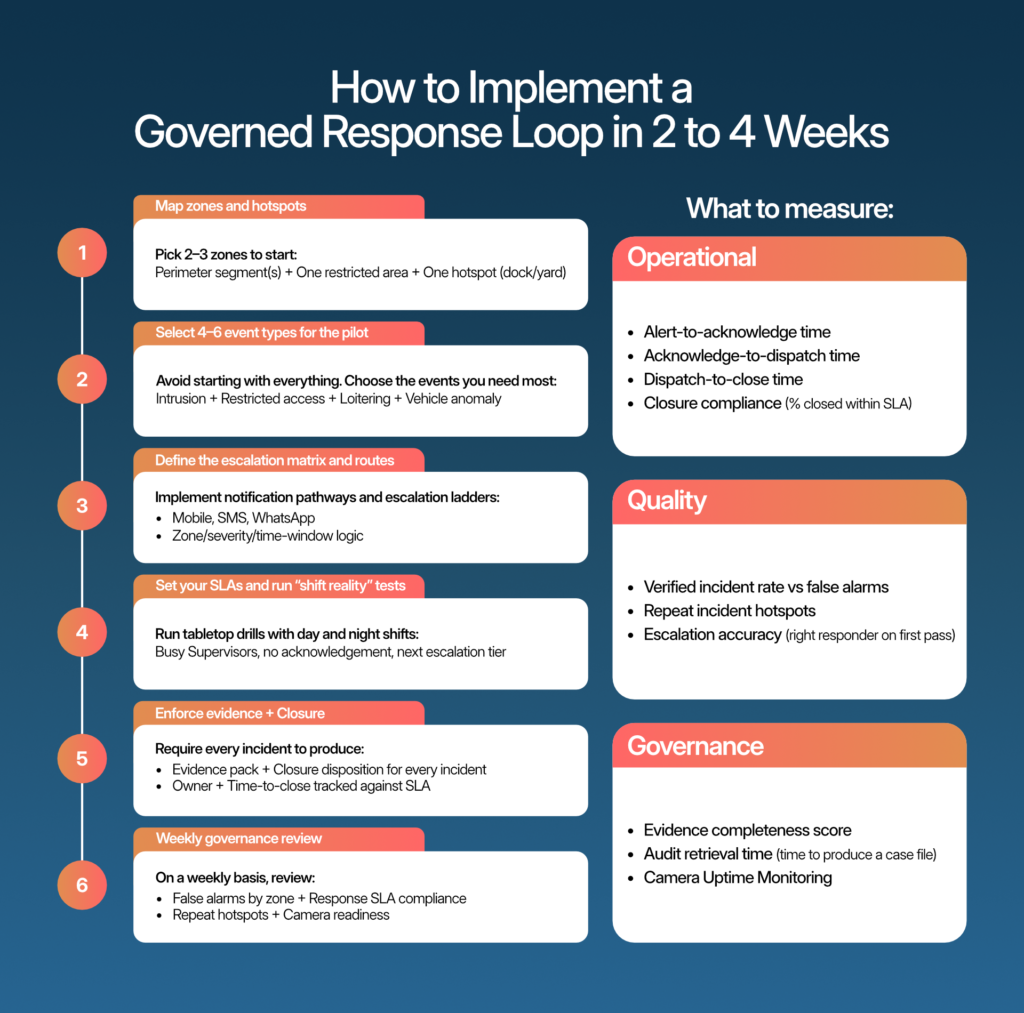
If you want to implement this quickly across sites, package it as a standard operating kit. It ensures consistent configuration, repeatable rollout, and faster adoption without redesigning the response model for each location.
Download: “Governed Response Loop Kit for Industrial Security”
The kit provides:
- Escalation Matrix Template (zone × severity × time window)
- Incident Triage + Dispatch SOP (roles, SLAs, escalation ladder)
- Evidence Pack Checklist + Retention Worksheet (audit-ready case file)
- Pilot Scorecard (metrics to prove effectiveness)
- Security Hotspot Mapping Sheet (zones, cameras, risk levels)
FAQs
1. What is the difference between alerts and a governed response loop?
Alerts notify you. A governed response loop ensures routing, SLAs, evidence, and closure so, incidents are handled consistently across shifts and sites.
2. What should be in an escalation matrix?
An effective escalation matrix defines zone, severity, time window, notification route, and fallback escalation tiers aligned to your security team protocols
3. How many event types should we start with?
Start with 4–6 high-value events (intrusion, restricted access, loitering, vehicle anomalies) and expand once response performance stabilises.
4. What does “audit-ready” documentation mean for security incidents?
It means you can quickly produce a complete case file: event details, video evidence, escalation log, actions taken, and closure disposition supported by retention policies.
5. How do we prevent “who is on shift” from determining response quality?
Use SLAs and escalation ladders. If an alert is not acknowledged within the window, it automatically escalates to the next tier.
6. Can this work with our existing CCTV and VMS?
Our system is designed to leverage existing CCTV and work with common IP camera/VMS environments. Request a diagnostic to find out compatibility with your infrastructure.
7. How long does a governed response pilot take?
A practical pilot is typically 2–4 weeks: 20–50 cameras, 2–3 zones, 4–6 events, with the escalation matrix and evidence pack enforced.
8. What is the fastest way to prove value to stakeholders?
Measure response SLAs, evidence completeness, and false-alarm reduction while showing consistent closure records across shifts.