
Contents In This Blog
Why Evidence Defines the Effectiveness of Security Operations
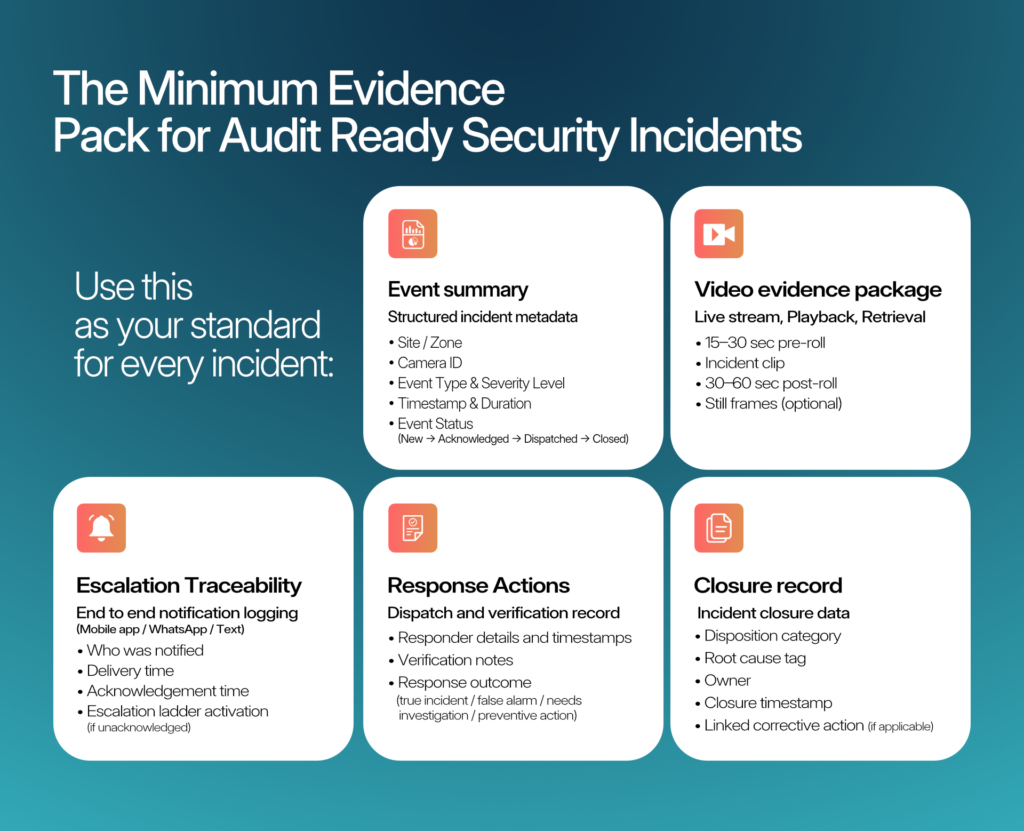
A resolved incident without documentation remains a risk. In industrial environments, security teams operate under continuous operational scrutiny and formal audit requirements for incident documentation. This is why AI security monitoring must deliver a complete evidence trail as a core capability, including live video, playback and retrieval, automated logging, and governed video retention for investigations.
The real question is not “can you detect?”
It is: “Can you produce a complete case file in minutes and prove detection → escalation → closure?”
What Defines Audit Ready Evidence in Practice
Audit-ready evidence has five properties:
- Complete: All steps captured including detection, escalation, response & closure.
- Timestamped: Machine timestamps for every action and notification.
- Attributable: Clear ownership showing who acknowledged, dispatched, and closed.
- Retrievable: Quick export as a structured incident case file.
- Retained: Policy based retention rather than ad hoc storage.
Retention Policies: A Practical, Defensible Structure
A tiered model with automated logging and video retention policies is both defensible and easy to operate:
- High severity incidents: Longer retention with restricted access.
- Medium severity: Moderate retention.
- Low severity / False alarms: Shorter retention periods.
- No-event footage: Minimal retention defined by policy.
Why Evidence Reliability Depends on System Readiness
Evidence trails are only reliable when footage exists. This makes 24×7 camera uptime monitoring essential for identifying downtime or feed interruptions and supporting audit requirements. Evidence governance without readiness governance remains incomplete.
Common Operational Gaps That Undermine Security Audits:
- Evidence requires manual exports from VMS for each incident.
- Notifications happen on calls or WhatsApp without logs.
- Closure is recorded as free text without standard dispositions.
- Retention depends on available storage rather than defined policy.
- Camera outages are identified only after incidents occur.
Key Metrics That Indicate Evidence Readiness:
- Evidence completeness rate - Based on full case availability.
- Case file retrieval time - Measured in minutes to produce dossiers.
- Closure SLA compliance - Measured by percentage closed within targets.
- Repeat hotspots - Identified by recurring incidents in the same zone.
FAQs
1. What is a security evidence trail?
A documented record of detection, escalation, response actions, and closure—supported by video evidence, logs, and retention policy.
2. What should be included in an audit-ready incident case file?
Event metadata, video clips (pre/post roll), escalation logs, responder actions, and closure disposition .
3. How long should security incident footage be retained?
Retention should be tiered by severity and aligned to internal governance and applicable regulatory expectations.
4. Why is escalation traceability important?
It proves response governance—who was notified, when they acknowledged, and what actions were taken.
5. How do you reduce manual effort in incident documentation?
Use automated logging + packaged clips and structured closure records.
6. What happens if the camera feed is down during an incident?
You lose evidence. That’s why uptime monitoring and downtime reporting is foundational .