Most industrial sites do not struggle with issuing permits. They struggle with maintaining control once permits are issued.
Permits are created. Approvals are completed. Signatures are recorded. Yet during execution, when work actually takes place, organizations are often unable to answer a few critical operational questions with confidence:
- Is the permitted work being executed exactly as approved?
- Are safety conditions still valid in the field, right now?
- Can we prove compliance if something goes wrong?
This is where traditional permit to work systems reach their limits, and where intelligent permit to work systems change the operating model.
The evolution of PTW is not about digitizing forms. It is about converting permits from static documents into active safety controls.
Contents In This Blog
What Is an Intelligent Permit to Work System?
An intelligent permit-to-work system goes beyond digital paperwork. It functions as a decision and enforcement layer that:
- Auto-generates permits from maintenance tickets or work orders
- Classifies risk by permit type, zone, and activity
- Applies AI-driven checklists, PPE rules, and hazard controls
- Monitors compliance continuously during execution
- Creates a traceable audit trail covering permit creation, approval, execution, and final closure.
Where legacy PTW systems rely on human vigilance, intelligent PTW systems scale safety through automation and intelligence, addressing the limits of manual supervision across large volumes of permits and operating units.
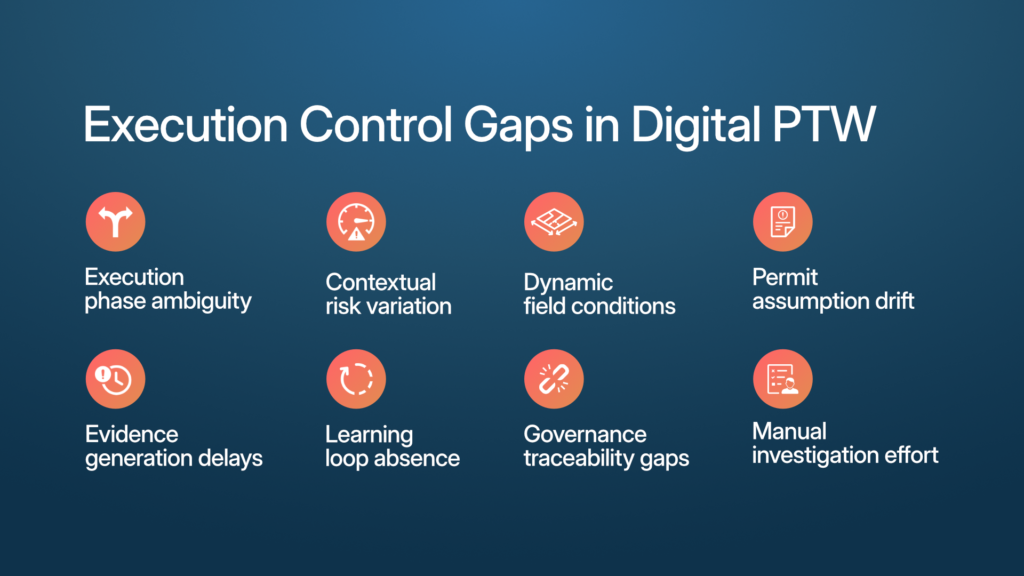
Why Permit Intelligence Requires More Than Digitization
Many organizations have already moved PTW systems to digital platforms. Despite this, incidents persist. Digitization improves speed and visibility, but not operational control.
True permit intelligence requires multiple layers. In most plants, only the initial layer is implemented.
1) Visibility of permits, not just approvals
Digital PTW systems indicate the number of open permits. They do not confirm whether work remains compliant. What operations require is visibility into active permits by zone, risk classification, and real-time status, beyond approval alone.
2) Visibility of context: zone, equipment, and activity risk
Identical permits may require different controls based on functional zone, equipment proximity, and activity type. Intelligent PTW correlates permit data with plant context so precautions adjust to where and how work is performed.
3) Visibility of execution: compliance, deviations, violations
Traditional PTW stops at permit issue. Intelligent PTW enforces controls from the moment a permit is issued. Linking permits with cameras and zones allows IPTW to identify non-compliance and support timely intervention.
4) Visibility of readiness: permits, people, and safeguards
Safety assumptions change during execution. Intelligent PTW tracks readiness conditions and alerts when permit assumptions are no longer valid.
5) Visibility of proof: audit-ready safety evidence
After an incident, investigators ask what was detected, who was notified, what actions were taken, and what evidence was retained. IPTW produces traceable evidence linking permits, approvals, observations, violations, and closures.
The Operational Decisions PTW Systems Must Support
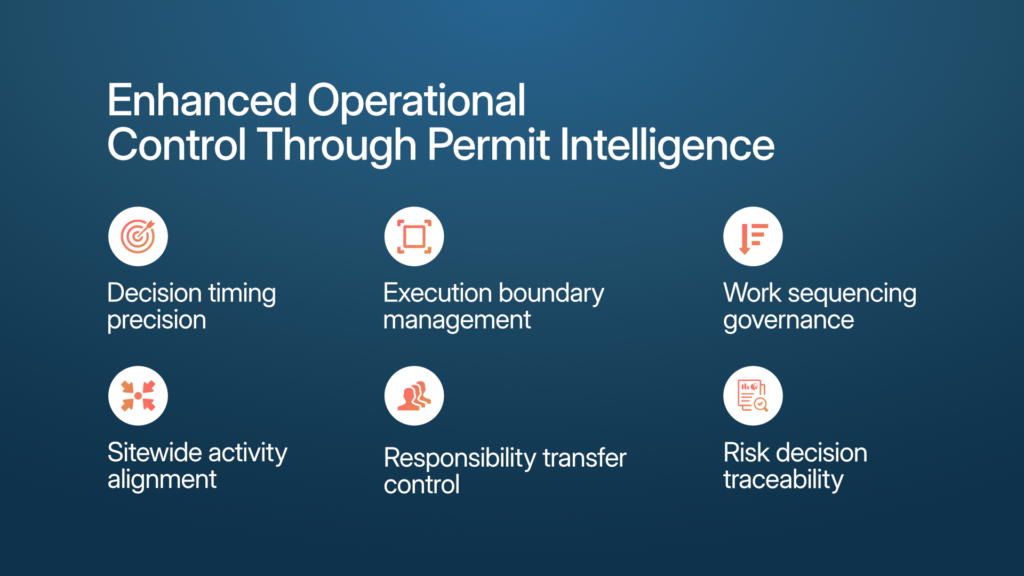
The primary value of intelligent PTW lies in enabling better operational decisions during work execution.
Decision A: Allow work to continue or intervene?
- Permit data: Approved activity and controls
- Visual data: PPE, barricades, safe behavior
- Context: Zone risk and time window
Outcome: Early intervention instead of post-incident investigation.
Decision B: Escalate or handle locally?
- Permit severity and activity type
- Zone criticality
- Real-time compliance signals
Outcome: Consistent escalation instead of ad-hoc judgment calls.
Decision C: Suspend, extend, or close permits?
- Execution progress
- Safety observations
- Time and condition validity
Outcome: Fewer unsafe extensions and overdue permits.
Decision D: Prove compliance during audits
- Permit history
- Checklist validation
- Visual evidence and timestamps
Outcome: Defensible audits with minimal manual effort.
Decision E: Improve permit safety over time
- Repeated violation patterns
- High-risk permit types
- Time-of-day safety trends
Outcome: Smarter controls, not more paperwork.
A Practical Model: The Intelligent PTW Control Loop
Intelligent permit to work systems create value by improving the quality and consistency of operational decisions. These decisions include dispatch or intervene, escalate, restrict access, investigate and close with evidence, and improve safety posture over time.
Plan → Permit → Monitor → Enforce → Learn.
- Plan: Integrate maintenance tickets and historical risk
- Permit: AI-generated scope, tools, PPE, and precautions
- Monitor: Real-time zone and permit compliance
- Enforce: Alerts, interventions, escalation
- Learn: Safety insights that improve future permits
This model represents the shift from issuing permits and governing work safely.
KPIs That Validate Permit Intelligence
The effectiveness of intelligent permit to work systems is reflected in measurable operational and governance outcomes. Key indicators include:
- Efficiency: Permit creation time, auto-generated vs manual, approval cycle time
- Compliance: Violations per permit type, PPE non-compliance rate, unauthorized work incidents
- Execution control: Overdue permits, unsafe extensions, interventions per active permit
- Audit & governance: Percentage of permits with complete evidence, traceability, time to audit readiness
Where Permit to Work Programs Commonly Fail
Where Permit to Work Programs Commonly Fail
- Treating PTW as documentation only: Enforcement must continue during execution.
- Overloading operators with checklists: Automation should reduce friction.
- No real-time feedback loop: Permits remain assumptions without monitoring.
- Ignoring safety intelligence: Insights must feed back into future permits.
FAQs
1. What is an intelligent permit to work system?
An intelligent PTW system automates permit creation, applies context-aware controls (PPE/checklists/hazards), supports approvals, and enables execution-time monitoring with audit-ready traceability.
2. How is intelligent PTW different from digital PTW?
Digital PTW digitizes forms and approvals. Intelligent PTW goes further by auto-generating permits from work orders, standardizing controls, monitoring compliance during execution, and producing actionable safety insights.
3. Does intelligent PTW replace safety officers or approvers?
No. It reduces manual effort and improves consistency, while approvals and decision accountability remain with authorized personnel.
4. Do we need an ERP like SAP to use IPTW?
No. IPTW can integrate with SAP/Maximo or operate as a standalone work request and PTW system where no ERP exists.
5. What data is typically required to start?
At minimum: work description, location/zone, equipment or functional location, and planned time window. More structured master data improves automation and reporting.
6. How does IPTW improve audit readiness?
It maintains a traceable record of creation, approvals, revisions, checklists, attachments (e.g., GHA), observations/violations, actions taken, and closure timestamps.
7. Can intelligent PTW support multiple permit types?
Yes. Permit types such as hot work, confined space, electrical, excavation, chemical handling, and site-specific categories can be configured with rules and templates.
8. Is intelligent PTW suitable for multi-plant standardization?
Yes. It supports centralized governance with plant-level configuration, enabling consistent reporting and KPIs across sites.