Permit delays are rarely treated as safety issues. They are more often viewed as administrative inefficiencies. In practice, permit delays are among the most consistent precursors to unsafe work, particularly during maintenance windows, shutdowns, and turnaround events.
When permits are delayed, work does not stop, it compresses. The compressed execution then introduces risk into the field.
Across industrial sites, three operational questions surface repeatedly when permits lag:
- How much productive time are we losing without noticing?
- What safety shortcuts are being forced by schedule pressure?
- Which delays are structural rather than situational?
Understanding the true cost of permit delays requires looking beyond approval timestamps and into how work is executed on site.
Contents In This Blog
Why Permit Delays Are More Dangerous Than They Appear?
Permit-to-work systems operate at the intersection of planning, safety, and execution. When delays occur at this point, their impact cascades across multiple teams. Permit delays influence safety in ways that are subtle, yet cumulative.
The Root Causes Behind Recurring Permit Delays
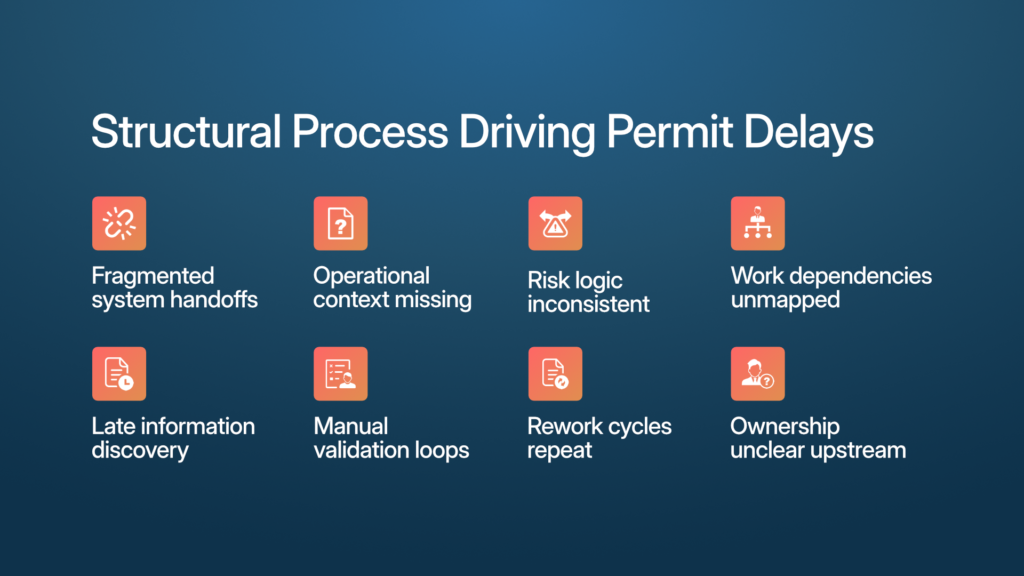
In most facilities, permit delays are not driven by a single bottleneck. They stem from layered inefficiencies embedded within traditional permit to work workflows.
Where permit delays actually originate:
- Re-entering work details already available in ERP tickets
- Waiting for sequential approvals instead of parallel validation
- Manual verification of equipment, zone, and hazard controls
- Late discovery of missing or inconsistent information leading to rework
- Manual risk assessment under time pressure
Delays do not eliminate work, they shift risk into execution:
- Compressed execution windows that encourage rushing and skipped controls
- Informal extensions and scope creep when validity windows are exceeded
- Erosion of safety discipline when PTW is perceived as an obstacle
Shutdowns concentrate risk by design:
- High permit density
- Overlapping work fronts
- Temporary workforce
- Compressed timelines
In these conditions, even minor PTW inefficiencies scale into systemic risk.
A five-minute permit delay multiplied across hundreds of permits becomes lost shifts, unsafe overlaps, and uncontrolled extensions.
Why Digitization Alone Fails to Address PTW Delays
Many organizations respond to permit delays by digitizing permit forms.
This improves legibility, but not workflow. Digital PTW without intelligence still depends on:
- Manual data entry
- Manual hazard selection
- Manual checklist construction
- Manual error correction
As a result, the bottleneck simply shifts from paper to screen.
How Intelligent PTW Removes Permit Delay at The Source
Intelligent permit-to-work systems address delays structurally, not procedurally.
1) Auto-generation from maintenance tickets
Permits are created directly from work orders, eliminating:
- Duplicate data entry
- Interpretation mismatches
- Missing context
Creation time drops from minutes to seconds.
2) Pre-validated risk and control logic
AI-driven PTW systems:
- Classify permit types automatically
- Recommend tools, PPE, and precautions
- Attach standard hazard analyses
Review time shifts from permit creation to verification.
3) Faster, more consistent approvals
When permits are complete and standardized:
- Rework reduces
- Approval variability narrows
- Bottlenecks become visible and manageable
This improves speed without compromising safety.
4) Controlled extensions and closures
Intelligent PTW systems track:
- Time validity
- Execution progress
- Safety observations
Extensions require reassessment rather than assumption.
The Operational Impact of Eliminating Permit Delays
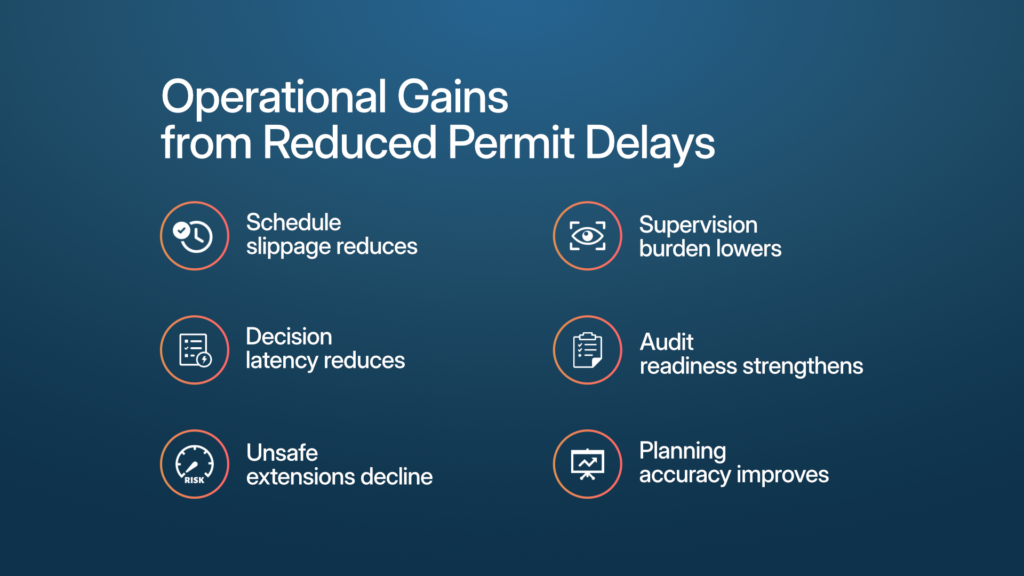
Organizations that address permit to work delays achieve measurable operational outcomes:
- Reduced maintenance idle time
- Fewer unsafe permit extensions
- Improved compliance during execution
- Higher audit readiness with less effort
Most importantly, safety is maintained without slowing work.
Rethinking Permit Delays as A Safety KPI
Permit delays should not be monitored as administrative metrics. They should be treated as leading indicators of operational risk.
Key questions to ask:
- Which permit types experience the most delays?
- Which zones generate repeated rework?
- How often do delays lead to rushed execution or unsafe extensions?
Addressing these questions requires intelligence, not additional paperwork.
Permit Effectiveness Depends on Execution Control, Not Speed
Eliminating permit delays is not about issuing permits faster at any cost. It is about ensuring work starts on time, is correctly defined, and remains safely controlled.
Intelligent permit-to-work systems enable this by removing friction where it adds no value and strengthening control where it matters most: during execution.
FAQs
1. Why are permit delays a safety risk and not just an admin issue?
Delays compress execution windows, increase schedule pressure, and raise the likelihood of shortcuts, unsafe extensions, and weak coordination, especially during shutdowns.
2. What are the most common causes of permit delays?
Duplicate data entry, sequential approvals, missing details discovered late, inconsistent permit classification, and rework during reviews.
3. How do permit delays impact maintenance productivity?
They create idle crew time, disrupt sequencing, increase waiting on approvals, and push work into overtime or off-hours, often at higher risk.
4. How can we measure the true cost of permit delays?
Track creation time, approval cycle time, rework/rejection rate, crew idle time attributable to PTW, and the number of overdue permits and extensions.
5. Do digital PTW forms solve permit delays?
Not fully. Digitization improves legibility and tracking, but delays persist if the workflow still requires manual entry, manual hazard selection, and repeated corrections.
6. How does IPTW reduce permit delays without reducing control?
By auto-filling from work orders, applying standardized controls/checklists, reducing rework cycles, and enabling faster, more consistent review.
7. What should be prioritized first, speed or governance?
Governance. The best systems reduce delays by improving completeness and consistency, not by skipping safety steps.