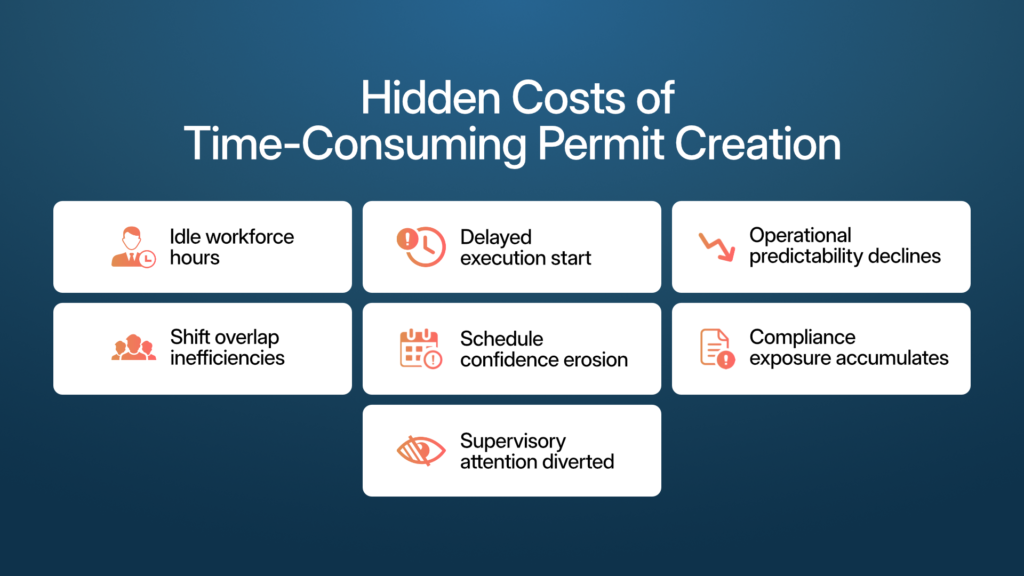
Permit creation is often treated as a routine administrative step. In practice, it is one of the most time-consuming and risk-defining activities in industrial operations.
Across refineries, manufacturing plants, and large industrial sites, creating a single permit typically takes 15 to 20 minutes, and often longer during maintenance peaks or shutdown windows. When repeated across dozens of permits per shift, this time burden becomes a structural operational cost.
AI changes this equation by eliminating repetitive effort that adds no safety value, allowing teams to focus on accuracy and control rather than manual processing.
Contents In This Blog
Why Permit Creation Remains Time-Intensive
Most delays in permit creation are not driven by complex work. They stem from manual repetition and human dependency embedded within legacy PTW processes.
1) Manual re-entry of maintenance data
Work orders already define:
- Equipment ID
- Location and functional zone
- Nature of work
- Planned time window
Yet permit issuers often retype or reinterpret this information introducing delay, inconsistency, and rework.
2) Rebuilding the same checklists repeatedly
Similar jobs require similar precautions. However, most systems still require users to:
- Recreate checklists from scratch
- Manually select PPE
- Attach standard hazard analyses
This effort consumes time without improving safety outcomes.
3) Late-stage corrections during approval
Approvers frequently return permits due to:
- Missing controls
- Incomplete PPE
- Incorrect zone selection
Each correction resets the clock.
The Scope of AI Automation in Permit Creation
AI does not replace approval authority. It ensures permits are prepared correctly at first submission. That difference matters in practice.
1) Auto-generation from work orders
AI-driven PTW systems extract structured data directly from:
- ERP maintenance tickets
- Standalone work requests
This eliminates duplicate entry and ensures the permit reflects the approved scope of work.
2) Intelligent permit classification
Based on job description, location, and equipment context, AI can:
- Recommend the correct permit category
- Select relevant sub-types (e.g., welding vs grinding)
- Apply templates aligned to risk levels
This brings consistency to permit classification across shifts and personnel.
3) Automated safety controls and checklists
Based on historical data and defined rule sets, AI:
- Recommends required tools and equipment
- Applies PPE rules automatically
- Attaches standard hazard analysis documents
Permit issuers shift from building permits to validating AI-generated permits.
4) Context-aware learning from past incidents
Advanced systems factor in:
- Previous non-compliance for similar jobs
- Zone-specific risk history
- Time-of-day safety patterns
This allows permits to evolve through operational learning.
What AI Deliberately Does Not Automate
A common concern in permit automation is loss of control. Well-designed IPTW systems address this directly.
AI does not:
- Replace safety officers
- Remove approval authority
- Override site rules
Instead, AI ensures human effort is focused on judgment and oversight rather than data entry.
How Permit Creation Becomes Faster
Faster permit creation is not the goal. It is the result of better preparation. Time reduces because:
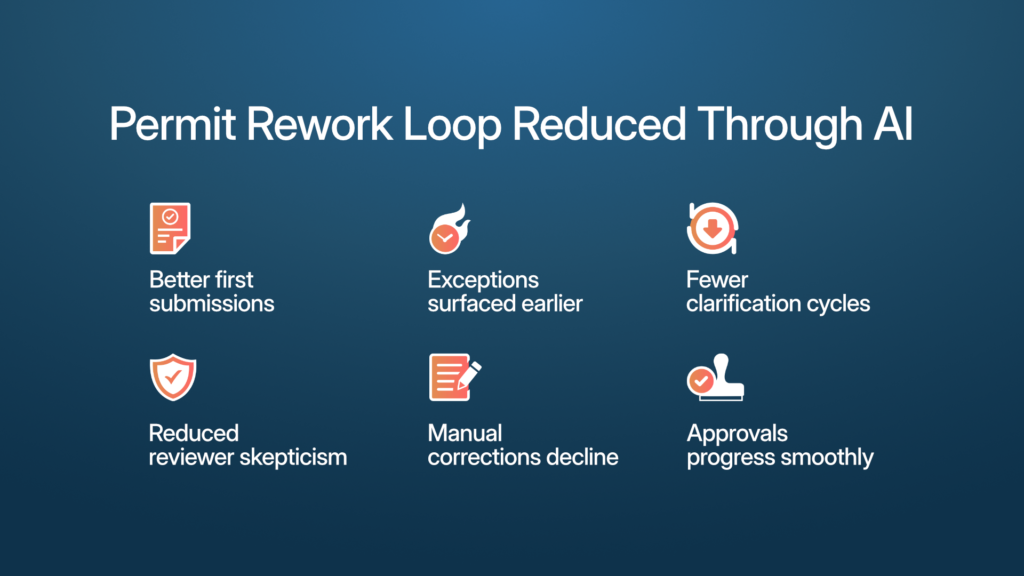
- Information is complete at first submission
- Checklists are consistent
- Rework cycles are reduced
- Approvers review fewer low-quality permits
What previously took 20 minutes becomes a 2-minute validation exercise.
How Faster Permits Influence Safety Outcomes
Faster permits do not automatically make work safer. Predictable permit issuance does.
When permits are issued quickly and consistently:
- Crews start work on time
- Execution is not rushed
- Extensions are reduced
- Safety controls remain intact
AI strengthens safety by removing time pressure from execution, not by accelerating risk.
Measuring the Impact Of AI-driven Permit Automation
Organizations implementing AI-driven PTW solutions commonly measure impact across efficiency, quality, and safety.
Efficiency metrics
- Average permit creation time
- Permits auto-generated vs manual
- Approval cycle time
Quality metrics
- Rework rate per permit
- Approval rejection rate
- Checklist completeness
Safety indicators
- Permit-related violations
- Unsafe extensions
- Incidents during active permits
Across deployments, the most significant gains consistently come from eliminating rework rather than increasing speed.
Common Pitfalls in AI-Driven PTW Adoption
- Treating AI as a shortcut: AI should standardize safety processes, not bypass them.
- Automating without governance: Clear site rules and permit taxonomies are essential.
- Ignoring learning loops: When insights arenot fed back into future permits, long-term value stagnates.
Aligning Permit Speed and Safety Through AI
Reducing permit creation time from 20 minutes to 2 minutes is not driven by urgency. It is about precision, consistency, and control.
AI-driven permit automation ensures:
- Every permit starts complete
- Every approval focuses on risk
- Every job begins with clarity
This is how organizations achieve both speed and safety together.
FAQs
1. What does AI automate in permit creation?
Data capture from work orders, permit classification, control recommendations (PPE/checklists/tools), and pre-validation of required elements, so users validate rather than build permits.
2. Does AI approve permits automatically?
No. Approvals remain role-based and authorized. AI supports preparation, standardization, and completeness.
3. What inputs does AI use to generate permits?
Typically: job description, zone/location, equipment ID, planned time window, and site rules/templates. Optional: historical non-compliance patterns and risk context.
4. How does AI reduce errors and rework?
By ensuring required fields, controls, and attachments are present at first submission and by applying consistent templates based on permit type and zone context.
5. What happens if AI recommendations are incorrect?
Approvers can edit, override, and enforce site rules. The system should capture revisions and reasoning for audit traceability and continuous improvement.
6. Will AI slow down the field due to extra checks?
Properly implemented AI reduces friction by removing redundant steps and improving approval quality. Controls remain risk-based, not blanket additions.
7. How do we prove the time savings?
Measure baseline creation time and approval cycle time, then compare post-deployment with the percentage of permits auto-generated and reduction in rework.