
In many organizations, permit approval is frequently perceived as the endpoint in the safety process. In practice, it marks the starting point of execution risk.
Most serious incidents associated with permit-controlled work occur after approval, not before. The exposure does not originate in documentation. It emerges during live operations.
For this reason, real-time permit compliance carries greater weight than approval alone.
Contents In This Blog
The Operational Risk Hidden Behind Permit Approval
Traditional PTW systems are built on a core assumption: once a permit is approved, work will be executed safely.
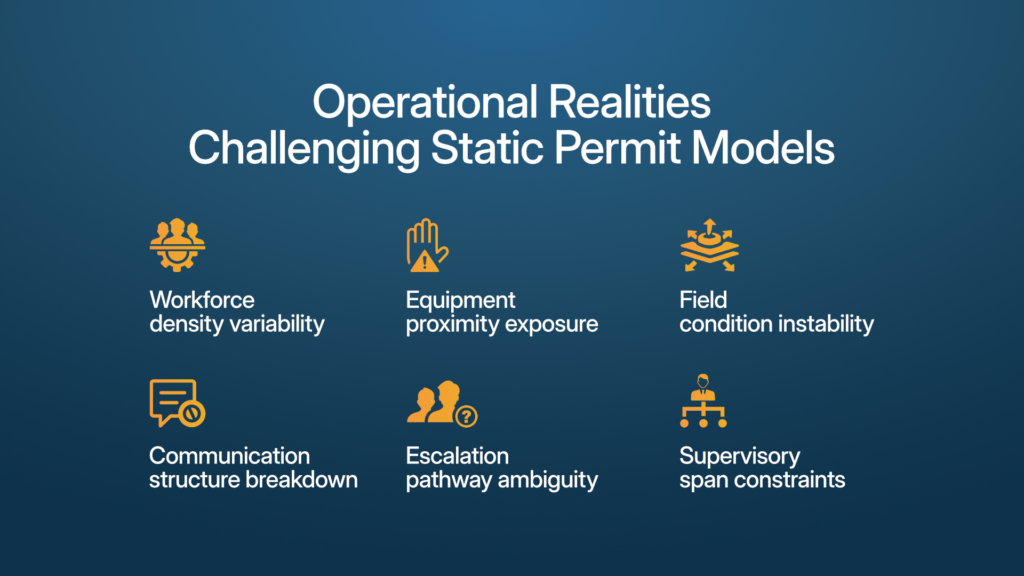
In operational settings, this belief weakens under real-world pressures, where:
- Conditions change during execution
- Multiple permits overlap in the same zone
- Supervision is limited, especially during nights or weekends
Approval confirms intent. Compliance validates alignment with reality.
When Approved Permits Fail in Live Environments
To understand why approval alone is insufficient, attention must shift to what occurs once work is underway.
1) Safety conditions change during execution
Controls validated at the time of issuance may lose relevance within hours:
- Barricades are moved
- Fire extinguishers are relocated
- Gas test validity lapses
- Temporary isolations are altered
Without continuous verification, permits depend on assumptions that may no longer reflect site reality.
2) Work deviates from approved scope
Under schedule pressure, crews may:
- Expand work boundaries
- Introduce additional tools or parallel tasks
- Continue beyond approved permit timelines
These deviations often go unnoticed until an incident occurs.
3) Human supervision does not scale
A single safety officer cannot continuously monitor:
- Dozens of active permits
- Multiple units or operational zones
- Simultaneous high-risk activities
Manual oversight remains fundamentally reactive.
Understanding the Role of Real-Time Permit Compliance
Real-time permit compliance is not about surveillance. It is about continuously validating that on-ground conditions remain aligned with approved permit parameters.
An intelligent PTW system enforces compliance by:
- Linking permits to physical zones
- Monitoring safety-critical behaviours
- Flagging deviations as they occur
- Enabling timely corrective intervention
Compliance becomes a live governance function instead of a post-event assessment.
How Intelligent PTW Enforces Compliance During Live Execution
1) Zone-linked permit monitoring
Each permit is mapped to:
- A designated functional zone
- Specified equipment
- An approved time window
This enables the system to determine precisely where work is authorized and within what timeframe.
2) Visual validation of safety controls
Through camera integration, intelligent PTW systems can identify:
- SOP violations
- Unauthorized personnel access
- Unsafe proximity to critical equipment
- Breaches of barricaded areas
This delivers objective validation rather than assumption-based oversight.
3) Time-based compliance checks
Permits remain valid only within sanctioned timeframes.
Real-time systems:
- Flag approaching expiry
- Require reassessment for extensions
- Prevent silent overruns
Time becomes a controlled variable, not a loophole.
4) Escalation and intervention workflows
When deviations are detected:
- Alerts are issued
- Escalation adheres to predefined protocols
- Actions are recorded with traceability
Response becomes consistent, even outside peak staffing hours.
The Safety Impact of Continuous Compliance Monitoring
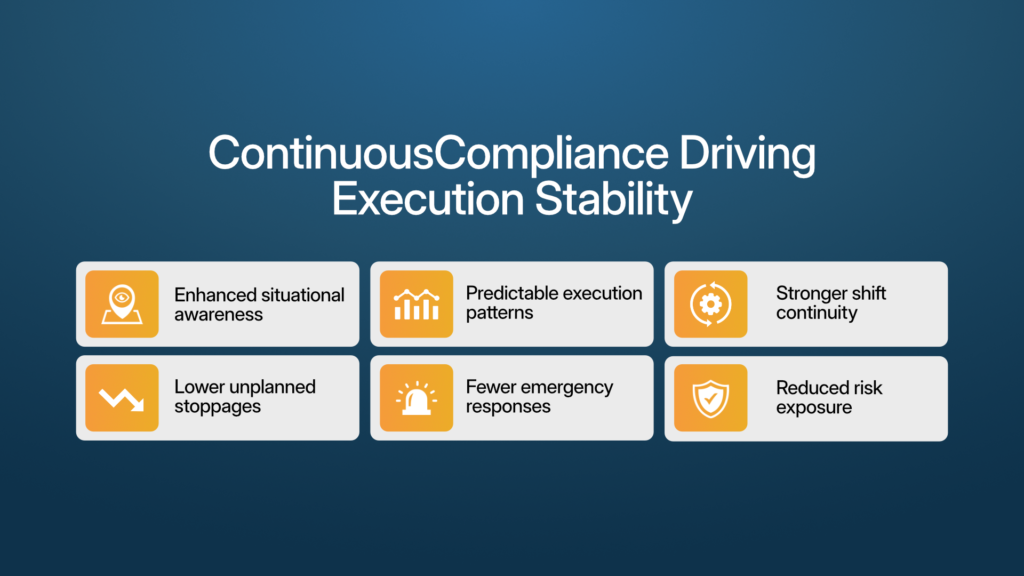
Real-time compliance transitions safety management from reactive response to preventive control.
Benefits include:
- Early detection of unsafe behaviour
- Reduced reliance on manual patrols
- Fewer permit-related incidents
- Stronger safety culture on accountability
Most importantly, it narrows the gap between prescribed safety standards and verified execution.
Quantifying Real-Time Permit Compliance
To embed compliance into operations, organizations track:
Compliance indicators
- Violations per active permit
- Frequency of PPE non-compliance
- Unauthorized work incidents
Execution discipline
- Overdue permit percentage
- Ratio of extension requests to approvals
- Time-based deviation alerts
Response effectiveness
- Time-to-acknowledge
- Time-to-intervention
- Closure completeness
These metrics provide early visibility into execution risk.
Addressing Misconceptions Around Real-Time Compliance
- Approval is sufficient if rules are followed – Rules without verification leave outcomes to assumption.
- Continuous monitoring will delay execution – In practice, it reduces interruptions by preventing unsafe rework.
- Existing audits provide sufficient oversight – Audits review historical performance. Compliance monitoring governs live execution.
Who Benefits Most from Real-Time Permit Compliance
Real-time compliance enhances both safety performance and operational continuity.
- HSE teams: Earlier visibility into emerging risk
- Operations: Fewer disruptions and stoppages
- Maintenance: Controlled extensions and closures
- Leadership: Defensible and transparent safety governance
Sustaining Safety Beyond Permit Approval
Permit approval establishes expectations. Real-time compliance ensures they are upheld.
In complex industrial environments, safety cannot rely on static documentation or periodic verification. It demands continuous visibility and timely intervention.
Intelligent permit-to-work systems enable this shift by transforming permits into active safety controls rather than approved paperwork.
FAQs
1. What is real-time permit compliance?
Continuous validation that ensures work remains within approved scope, time windows, and safety controls while the permit is active, not just at issuance.
2. Why is approval alone insufficient?
Because site conditions change, behaviours drift, SIMOPS conflicts arise, and supervision is not continuous, the real risk emerges during execution.
3. What kinds of non-compliance can be detected?
Examples include PPE violations, unauthorized access to permit zones, barricade breaches, work beyond validity windows, and deviation from permit rules.
4. How are compliance deviations handled operationally?
Through structured escalation workflows that include role-based alerts, acknowledgment tracking, intervention actions, and formal closure logging.
5. Will compliance monitoring increase alarm fatigue?
Not if the system is configured with scenario prioritization, zone/time rules, and strong closure discipline to maintain signal quality.
6. How do we measure real-time compliance effectiveness?
Track violations per active permit, time-to-acknowledge, time-to-intervention, closure completeness, overdue permits, and unsafe extensions.