
Most permit to work programs are structured around a single event: approval.
However, the highest exposure does not occur at issuance. It occurs during execution, when work is active, conditions evolve, and supervisory bandwidth is limited.
Leading industrial operations are therefore shifting focus from permit approval to permit enforcement.
Vision-based permit compliance enables this transition by leveraging existing camera infrastructure and edge/cloud analytics to continuously verify safety conditions while a permit remains active. The result is a shift from static documentation to an operational control layer embedded within live execution.
Contents In This Blog
The Execution Gap in Permit to Work Programs
A traditional PTW system operates on the assumption that once a checklist is signed, compliance is sustained.
In live industrial environments, that assumption does not hold. Safety discipline weakens because:
- Work drifts: Crews adjust scope, tools, and location to finish faster.
- Controls degrade: Barricades shift, fire watch discipline lapses, PPE compliance weakens.
- Zones overlap: SIMOPS introduces compounded exposure across adjacent active permits.
- Limited visibility: Patrols and supervision cannot scale to every job.
The outcome is predictable: permits appear compliant on paper, while execution diverges in the field.
What Is Vision-Based Permit Compliance?
Vision based permit compliance applies camera analytics mapped to defined permit zones and rule sets to detect and address PTW non compliance while work is actively underway.
A robust system typically performs four core functions:
- Associate permits to defined physical zones - Unit boundaries, equipment proximity, hazard areas.
- Monitors compliance signals visually - PPE adherence, barricade integrity, unauthorized access, unsafe acts.
- Triggers escalation workflows - Role-based alerts, acknowledgement tracking, closure logging.
- Creates an evidence trail - Event snapshots, timestamp records, actions taken.
This model is not about increasing surveillance. It strengthens operational control focused on the highest risk work.
The Operational Advantage of Cameras in Permit Governance
Industrial safety has traditionally depended on human verification:
- Safety officers patrol
- Supervisors check
- Audits review after the fact
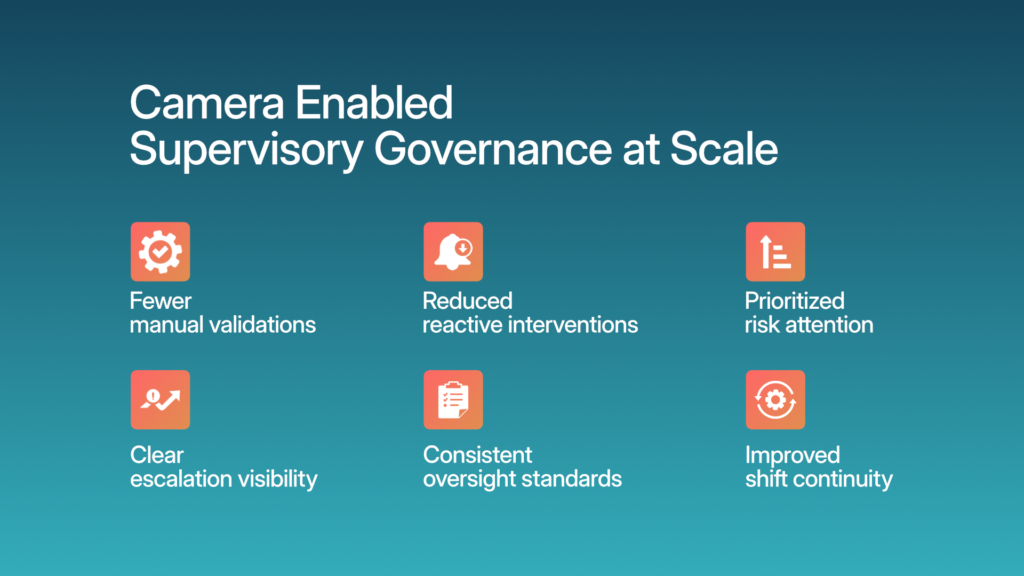
However, permits are often active across multiple zones at the same time. Cameras introduce capabilities that human oversight alone cannot scale.
1) Continuous presence without continuous manpower
Cameras are not constrained by meetings, shift transitions, or operational disruptions. They provide uninterrupted observation coverage.
2) Objective verification
A permit checklist records intent. A camera event provides evidence. This minimizes ambiguity during investigations and audit reviews.
3) Early deviation detection
Most incidents are preceded by minor deviations such as PPE lapses, barricade breaches, or unauthorized entry. Vision analytics enables earlier identification of these signals.
Critical Monitoring Conditions Under Vision Based PTW Compliance
The most valuable use cases are those that are high frequency, high consequence, and visually verifiable.
PPE compliance detection
- Hard hat, safety vest, gloves, goggles based on site-dependent
- PPE adherence in defined permit zones
- Repeat non-compliance patterns by zone or contractor
Restricted zone and barricade integrity
- Entry into barricaded work areas
- Breach of exclusion zones during hot work
- Loss or movement of temporary barricades
Unauthorized presence during permit execution
- Non-permitted personnel in active permit zones
- Crowd formation around hazardous work
- Tailgating into controlled areas when integrated with access control
SIMOPS risk signals
- Conflicting activities across adjacent zones
- Vehicle movement near active work fronts
- Unsafe proximity between people, vehicles, and equipment
Fire watch and hot work indicators configured per site
- Presence validation in designated watch areas
- Visual confirmation of work conditions as configured
The recommended approach is to begin with a limited set of scenarios aligned to clearly defined permit controls.
How Vision-Based Permit Compliance Works in Practice
A mature implementation operates through a governed control loop:
Step 1: Permit is created and issued
The system captures:
- Permit type (hot work, confined space, electrical, etc.)
- Zone / functional location
- Validity window
- Required controls including PPE, barricades, access rules
Step 2: Cameras are mapped to the permit zone
The system identifies:
- Cameras covering the designated area
- Nearest viewpoints
- Relevant analytics models aligned to permit type
Step 3: Compliance is monitored continuously
While the permit is active, analytics detect:
- Violations
- Unsafe conditions
- Unauthorized access
Step 4: Escalation workflows trigger action
Alerts route based on:
- Zone criticality
- Severity
- Time window (day shift vs after-hours)
- Role-based escalation (safety officer → supervisor → operations)
Step 5: Evidence is retained and closure is logged
The system records:
- Event timestamps
- Policy governed snapshots or clips
- Actions taken
- Closure notes and approvals
This elevates the permit from documentation into a measurable control process.
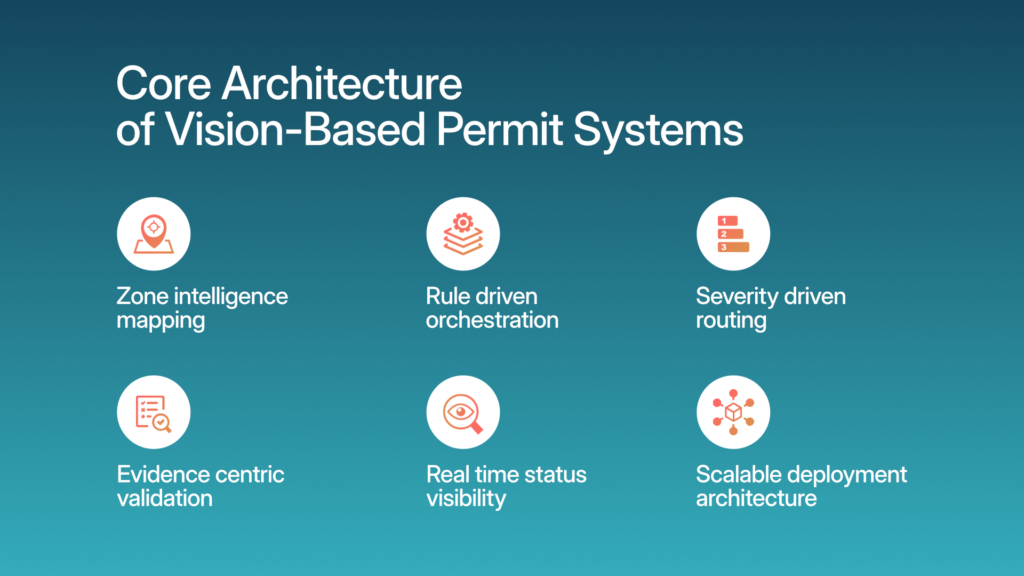
Operational Architecture of Vision Based PTW Enforcement Layer
A practical way to structure vision-based permit compliance is through a defined operational loop:
Permit → Verify → Escalate → Close → Learn
- Permit: AI-generated scope, controls, and validity
- Verify: Visual validation aligned to permit type and designated zone
- Escalate: Governed response workflows with acknowledgement tracking
- Close: Structured closure supported by documented evidence trail
- Learn: Operational insights that strengthen future permits and workforce training
This enforcement layer remains absent in many traditional PTW frameworks.
KPIs That Validate Vision Based PTW Enforcement Performance
Sustainable performance should be evaluated through measurable control outcomes rather than alert volume alone.
Signal quality
- Violations per 100 active permits
- Verified violations Vs False triggers
- Top violation drivers by permit type / zone
Response performance
- Time-to-acknowledge (TTA)
- Time-to-intervention (TTI)
- SLA compliance by severity
Execution discipline
- Overdue permits and unsafe extensions
- Repeat violations by contractor / crew
- SIMOPS conflict alerts resolved
Audit readiness
- Percentage of permits with complete evidence trail
- Percentage of violations closed with documented action
- Reduction in investigation cycle time
Common Implementation Pitfalls in Vision Based PTW Enforcement
1) Treating compliance as an alert stream
In the absence of structured escalation and closure governance, alerts become operational noise.
Fix: Define escalation workflows and closure ownership from day one.
2) Expanding scope too quickly
Monitoring everything simultaneously increases noise and accelerates alarm fatigue.
Fix: Begin with 3–5 scenarios aligned to high-risk permits and critical zones.
3) Lack of permit and zone linkage
Generic video analytics without permit context weaken decision quality.
Fix: Bind alerts to permit ID, zone, and applicable controls.
4) Overlooking system readiness
If camera feeds fail without visibility, enforcement collapses.
Fix: Implement uptime tracking and feed health monitoring for critical coverage areas.
Sustained Enforcement Determines Permit Effectiveness
Approval is a snapshot. Compliance is a continuous discipline.
Vision-based permit compliance addresses the execution gap by verifying critical controls in real time, enabling faster intervention, and generating audit ready evidence trails without dependence on unlimited supervisory presence.
This is how permits evolve from procedural documentation into operational safety control layers.
FAQs
1. Do we need new cameras for vision-based compliance?
Generally, no. Deployments commonly utilize existing CCTV or VMS infrastructure, with coverage quality guiding which zones are suitable for initial pilots.
2. What scenarios are best for a first pilot?
High-frequency, high-consequence, visually verifiable scenarios such as PPE compliance, restricted zone entry, barricade breach, and unsafe proximity.
3. How are camera events tied to permits?
By mapping cameras to defined permit zones and linking alerts to permit IDs, permit types, validity windows, and severity parameters.
4. How do you prevent false alarms?
Use well-defined scenarios, zone/time policies, model tuning, and a governed escalation/closure workflow to maintain signal quality.
5. What about camera downtime and feed health?
Camera uptime monitoring is critical. Without it, enforcement can fail without visibility. Mature systems track uptime, frozen feeds, and interruptions.
6. Where should analytics run: edge, on-prem, or cloud?
It depends on latency, connectivity, and data governance. Industrial deployments commonly use edge/on-prem for real-time enforcement and centralized reporting for multi-site visibility.
7. How is evidence stored for audits?
Through policy driven retention of event metadata, approved snapshots or clips, action logs, and closure notes, all linked directly to the corresponding permit record.