
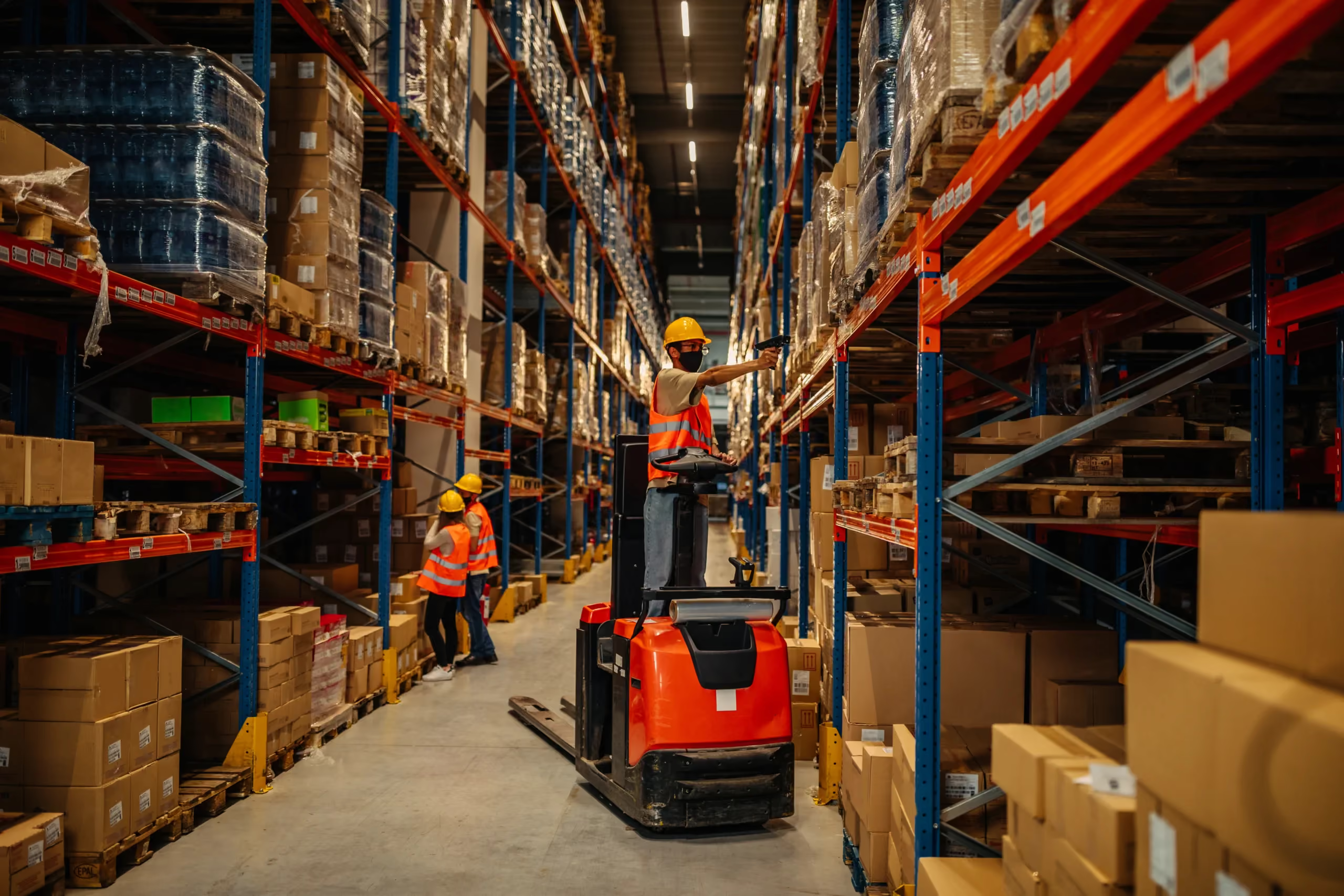

Forklift blind spots remain one of the most persistent safety challenges in warehouses and industrial facilities worldwide. Even with experienced operators, obstructed views caused by elevated loads, reversing maneuvers, narrow aisles, and high racking contribute significantly to collisions and near-misses. In high-density or high-throughput operations, these limitations become especially critical.
For EHS and operations leaders, the key question is no longer whether to address blind spots, but how to do so most effectively. This article compares traditional visibility aids with modern intelligent detection systems and outlines clear paths to improved safety outcomes.
Contents In This Blog
The Scale of the Blind Spot Challenge
Blind spots are not simply a matter of operator inattention. They stem from fundamental forklift design, load dynamics, and warehouse realities. Industry data underscores the impact: forklifts were associated with 84 fatalities in the US in 2024 and an estimated 35,000–62,000 injuries annually. Extended shifts, common during peak periods, can increase injury risk by up to 37%. Struck-by incidents involving limited visibility remain a leading cause of serious forklift-related injuries.
These statistics reflect real operational conditions where operators must constantly compensate for obstructed views while managing speed, loads, and pedestrian traffic. When cognitive load rises due to congestion or fatigue, the risk of incidents increases substantially.
Traditional Mirrors and Spotlights: Established Tools with Clear Limitations
Convex mirrors, rear-view mirrors, and blue spotlights have served as standard visibility aids for decades. Their primary strengths include cost-effectiveness, ease of installation, and expansion of the operator’s field of view.
However, their limitations become evident in modern warehouse environments:
- Views are static and can be distorted or obstructed by loads and positioning.
- Spotlights improve general awareness but do not detect movement or provide predictive alerts.
- Both solutions depend entirely on the operator noticing and correctly interpreting information in real time which is a significant challenge under pressure or fatigue.
- Effectiveness decreases significantly in congested areas, low-light conditions, or during periods of high operational intensity.
Many facilities report that while these tools reduce some incidents, they do not deliver the consistent protection required in today’s complex operations.
Intelligent Detection: A Proactive and Scalable Approach
Intelligent Collision Avoidance System (ICAS) from Detect Technologies combines computer vision and on-device AI processing with forklift-mounted cameras that create a circular detection perimeter around the vehicle. This enables continuous real-time monitoring of surrounding people, vehicles, and obstacles, providing proactive support beyond mirrors, spotlights, and passive visibility aids.
Key capabilities include:
- Real-time detection of pedestrians (in any posture), other vehicles, and obstacles even in blind zones.
- Low-latency alerts that give operators critical additional response time.
- Emergency control integration supporting automatic forklift slowdown or stop during critical events.
- Real-time operator dashboard displaying detected objects and their movement within the defined radius.
- Tagless operation, which is particularly effective for mixed and temporary workforces.
- Automatic logging of near-miss events, enabling data-driven improvements to layouts, procedures, and training.
This technology augments human capability rather than depending solely on it, delivering more reliable performance under demanding conditions.
Direct Comparison: Traditional Aids vs Intelligent Detection
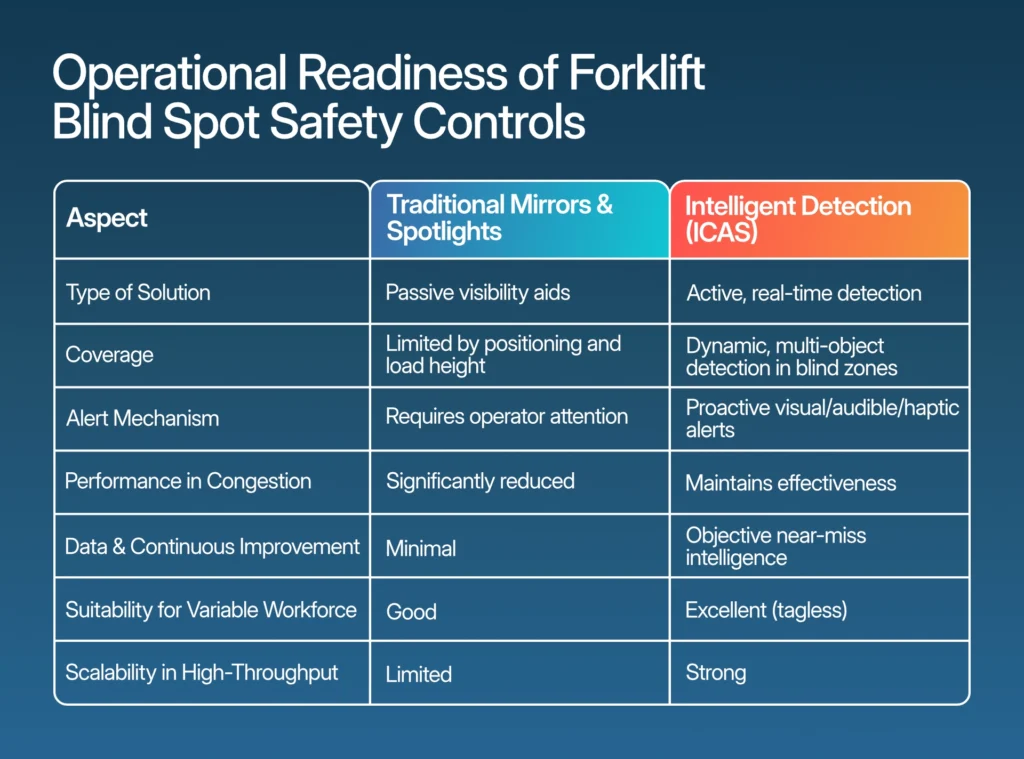
This comparison demonstrates that intelligent systems complement rather than replace traditional tools, creating a more robust layered safety approach.
Key Strategies for Stronger Blind Spot Control
Leading global operations strengthen blind spot management through a structured, layered approach:
- Retain and optimize mirrors and spotlights as the foundational visibility layer.
- Implement intelligent detection across forklifts fleets, traffic routes, and operating zones.
- Utilize near-miss data to identify recurring patterns and refine layouts or procedures.
- Conduct regular risk assessments focused on blind-spot-prone maneuvers and high-traffic areas.
- Evaluate solutions based on reliability in industrial conditions, ease of use, and integration potential.
This integrated strategy supports both immediate risk reduction and long-term safety performance improvement.
Advancing Toward More Reliable Warehouse Safety
Blind spots are an inherent aspect of forklift operations, yet they no longer need to represent an unmanageable risk. By thoughtfully combining established visibility aids with intelligent detection technology, organizations can achieve more consistent real-time awareness, reduced collision risk, and greater operational resilience across global facilities.
Ready to strengthen blind spot management in your operations? Explore how Detect Technologies’ ICAS can complement your existing safety measures with reliable, real-time detection and actionable insights.
FAQs
1. What are the most dangerous blind spots for forklifts in warehouses?
The highest-risk areas typically occur when loads are elevated (blocking forward vision), during reversing, at intersections, and in narrow aisles with high racking. Congestion and variable lighting further increase the likelihood of incidents.
2. Can traditional mirrors and spotlights be combined with intelligent detection?
Yes. The most effective approach is layered: traditional aids provide baseline visibility while intelligent systems add proactive detection and alerts.
3. How does intelligent detection technology address blind spots?
Edge AI computer vision continuously monitors the surroundings and detects people and objects in real time, even in areas where the operator’s direct view is obstructed. It delivers timely alerts to support faster and more informed responses.
4. Is implementing intelligent collision avoidance complex?
Modern systems are designed for practical deployment with minimal infrastructure changes. Many solutions can be rolled out in phases, focusing first on highest-risk areas or vehicles.
5. What benefits can organizations expect from intelligent blind spot solutions?
Facilities commonly report fewer near-misses, better objective safety data for continuous improvement, greater operator confidence, and reduced collision risk particularly in complex or high-throughput environments.
The highest-risk areas typically occur when loads are elevated (blocking forward vision), during reversing, at intersections, and in narrow aisles with high racking. Congestion and variable lighting further increase the likelihood of incidents.
Yes. The most effective approach is layered: traditional aids provide baseline visibility while intelligent systems add proactive detection and alerts.
Edge AI computer vision continuously monitors the surroundings and detects people and objects in real time, even in areas where the operator’s direct view is obstructed. It delivers timely alerts to support faster and more informed responses.
Modern systems are designed for practical deployment with minimal infrastructure changes. Many solutions can be rolled out in phases, focusing first on highest-risk areas or vehicles.
Facilities commonly report fewer near-misses, better objective safety data for continuous improvement, greater operator confidence, and reduced collision risk particularly in complex or high-throughput environments.
Are you ready to experience T-Pulse?
Meet highest compliance, monitor all occupational risks, and get recommended actions to achieve global safety benchmark. Schedule a demo
